
The Chool Bus (ch37)

CHAPTER 37: Sweet home Alabama

The drive from Vicksburg to Mobile was uneventful, giving Billie ample time for quiet reflection. The plan was to visit the battleship USS Alabama and the submarine USS Drum before settling into a quiet Foley RV park near Columbia Southern University, with focus-group sessions scheduled at the Orange Beach campus. Buck was keeping the road-trip tunes eclectic and interesting. But as the Chool Bus crossed into “Sweet Home Alabama,” the selection pumping out of the speakers, Werewolves of London, had a familiar ring to it. Jack was in the back of the bus struggling with why that particular song and the Welcome to Alabama sign were connected. Out of the blue, Buck piped up, “Wasn’t that song challenged for copyright by Lynyrd Skynyrd… did they win the case? If so, wouldn’t that indicate an unfair advantage for Goliath over David? In other words, copyright cases determined by whose legal team can whoop whose?”

That reminded Jack of some of the motivations behind the Creative Commons movement. “Now, CC co-founder Lawrence Lessig didn’t say that explicitly, but i agree, Werewolves of London and Sweet Home Alabama sound nothing alike despite the fact they share a common chord progression.” It was still kinda fuzzy in Jack’s memory.

“There was no copyright case,” Professor T cut in. He remembered a dust-up over Kid Rock’s appropriating Sweet Home Alabama and Werewolves of London with a thing called All Summer Long, but that case was settled by Kid’s people… getting clearance from both Zevon’s and Skynyrd’s organizations.

“Now, Zevon did seem to address a feud between Neil Young and Skynyrd back in the ’70s,” said Professor T. “It was an unflattering song about some of the Deep South’s worst history, and Young’s song, Southern Man, painted the entire region with a broad racist brush. Play It All Night Long, i believe it was called.”

None of this penetrated Billie’s silent reverie behind the wheel. She was reliving the visit to the haunted McRaven House in Vicksburg. She always felt similar to that FBI character in the TV series, X-Files. Like agent Mulder, she really wanted to believe, but there were never any solid reasons to give in. Besides, she was surrounded by academics. The Pragmatic, mildly paranoid cyber-security specialist, Jack, and the media scholar, Professor T. To convince either one of them would require a cargo-ship load of objective, verifiable evidence and replicable proofs.

But… on the one hand, Billie knows humankind doesn’t understand universal forces completely. There may be several “theory of everything” frameworks bouncing around, but Billie knows these frameworks are no different than philosophy or religion at this point. Look at quantum entanglement: particles interacting across massive distances instantly, she thought. If science can prove something that inexplicable, why is it so hard to believe that human consciousness might exist outside the body, or that there are forces, spirits, or dimensions we can’t perceive yet?

But her inner skeptic is never far, and that brought her to remember something she picked up surfing the science corners of YouTube. Human brains are hardwired pattern-recognition machines. We see faces in the dark, we misremember details to fit the stories we tell ourselves, when we’re tired or stressed, sometimes we experience sleep paralysis or auditory hallucinations. Like Professor T often reminds students, “…anecdotes aren’t data. If supernatural phenomena were real, they would be repeatable under controlled, scientific conditions. Yet, every single time a psychic or a haunted house is subjected to rigorous, double-blind testing, the spooks vanish.”

Billie’s inner dialogue was heating up. Millions of people throughout history, across completely isolated cultures, have reported ghost encounters, premonitions, and near-death experiences. Are they all just lying or hallucinating? It feels incredibly arrogant to assume humanity has the universe entirely figured out… it doesn’t. I know Jack and Mork Thompson agree about that.

Again, science requires strict, repeatable conditions, and the supernatural, by its very definition, operates outside conventional physical laws. There are no proton packs or spook traps like in the Ghostbusters movies. You can’t just trap a soul or residual energy in a containment unit. And honestly, looking at the world through a purely materialistic lens feels cold and reductive. Believing in something greater… a mystery, an afterlife, a spiritual connection… gives life a sense of wonder and meaning. It gives people hope that death isn’t just a consciousness switch flipping off forever, she thought.

Finally, the voice of Billie’s beloved father piped up, like always, to settle the matter: “Finding comfort in an idea doesn’t make it true, Billie. Wishing for an afterlife or a cosmic connection is just a coping mechanism for fear of the unknown and our own mortality.” The last time she and her father visited this topic, he told her, “Accepting the material world as it is makes life more profound, because this one is all we’ve got. Relying on supernatural explanations actually stops us from looking for real answers. Throughout history, lightning, disease, and mental illness were all blamed on gods and demons until science found the actual causes. Magic is just the placeholder we use for things we haven’t explained yet.”

“Fine,” she whispered. And with that memory, Billie and the bus pulled into Mobile’s Battleship Parkway. Time for a walking tour of the USS Alabama and the submarine Drum.

NEXT WEEK:
Thanksgiving dinner with family in Savannah, Georgia.

GO BACK => Preface and Chapter Links
The Chool Bus (ch32)

CHAPTER 32: The gang conducts interviews at Oklahoma State University before venturing into the hot spring paradise and pothole central of Arkansas.

Billie was glad to turn the wheel over to Buck after stopping at the National Route 66 Museum in Elk City, Oklahoma. The drive reminded her of that stretch of Interstate 70 between Abilene, Kansas, and Denver: endless prairie grass, crops, and cattle. It was a landscape mostly devoid of civilization, its boredom occasionally shattered by bus-rocking wind gusts and tumbleweed attacks. But Route 66 has a storied history, and Professor T couldn’t help thinking about the wild anecdotes Jack Kerouac included in that classic scroll known as On the Road. He (Professor T) was almost disappointed that the route couldn’t be covered on more of those two-lane stretches where Neal Cassady drove the rattlin’ Hudson like a maniac, pushing over 100 mph, passing semis on the dirt shoulder with inches to spare while talking non-stop about jazz, time, and cosmic revelations.

The trip reminded Jack Dean of those heady years when The Forks made their way around the country with their grunge-metal songs and mosh routines. They were a fairly nihilistic bunch, but not inclined to push as close to the edge as those storied Beat Poets or Gonzo Journalists of post-war America. They were mostly happy to read about the “edge” and experience it vicariously.

There was that wild experiment in Laramie, Wyoming, with that “Fozzy” character, but afterward, Jack was less inclined to get boosted on amphetamines and oppressive heat…sweat flying out of windshields with manic companions huddled in the backseat clutching notebooks, all convinced they were going to disintegrate into the prairie like that flash at the end of the 1971 movie Vanishing Point.

“You know, Buck,” said Jack. “Rodeo cowboys pushing their luck on raging beasts are not at all unlike the crazy beat poets, gonzo journalists, and 27-club luminaries.”

“You mean like Kerouac, Burroughs, and Hunter S Thompson? I get those references, but what’s a ’27 Club’?” Buck suspected this had something to do with Billie’s favorite rock star.

“I’m sure that ’27 Club’ syndrome correlates closely with the age at which young men finally develop some frontal lobe perspective,” said Professor T. “I haven’t really given it much thought.”

“Again with the stubborn, sexist omission of ladies as impactful human beings,” Billie said, clearly annoyed.

“Hello?” whined Buck. “What the hell is a ’27 Club’?”

Jack was the Forks’ foremost expert on nihilistic hedonism, so he took over. “Well… it’s a fairly long and sad list of beloved music artists shuffling off the mortal coil at age 27.”

“I, too, had a radical turn of karmic trajectory at that age. I can still see the scene vividly: the day i stopped chasing parties, booze, girls, and cocaine. Walking from the parking lot to my apartment after one of those pointless all-nighters, the sun blazing in my face, i was reviewing all the wasted dollars and precious time spent with people who would never be considered friends. I was 27 when i made that turn. I made it out of that phase alive… the 27 Clubbers did not.”

“Give us some names,” said Billie. “I did read about Cobain being part of something like that,” she was slowly shaking her head. “Twenty-seven is way too young for checking out.” Billie was devastated by the news of grunge’s foremost luminary.

“Okay… but it’s a long, depressing list,” said Jack. “Robert Johnson, Jim Morrison, Janis Joplin, Brian Jones, Jimi Hendrix, Amy Winehouse, and Billie’s favorite, Cobain. Neil Young once wrote, ‘It’s better to burn out than to fade away,’ and every member of the 27 Club did just that. It’s ironic Young is still with us, but as a musical journalist of sorts, i guess it’s good he survived the curse. ‘The Needle and the Damage Done’ is another example. It’s like there is a chasm across an artist’s timeline. You either have the will and ability to clear it, or you join the club. You either cross it and gain wisdom as you fade away, or you dispense all the wisdom you have by 27 and check out early.”

Rolling into Cushing Oklahoma, the scent of raw sulfur and heavy hydrocarbons wafted from the tank farms, seeping into the bus through the ventilation and cracked windows. At the fuel stop, Billie asked a local if that was normal. “Oh, that’s a good smell… means things are still hummin’ ’round here.” With a deadpan shrug while paying for her soda and candy bar, she mumbled, barely audible, “…it just smells like money to me.”

In the pre-interview discussions at OSU, Billie pressed on the unique situation Cushing residents face. She learned that despite billions of dollars in oil sloshing beneath and around the town in pipes and barrels, very little of that capital actually sticks to Main Street. Like many legacy energy hubs, the infrastructure is owned by multinational corporations, leaving the local tax base to deal with heavy road wear, crumbling asphalt, and rural infrastructure strain without a fair return.

As a consolation prize for rising to the top of the world’s natural gas producers, Cushing has become ground zero for human-induced seismic activity…the result of excessive fracking. In the 2010s, a rash of earthquakes shook the prairie, including at least one 5.0 magnitude quake that damaged historic downtown brick facades.

If that wasn’t enough, the locals live with the underlying anxiety of residing adjacent to tens of millions of barrels of volatile hydrocarbons. After all, a severe thunderstorm, lightning strike, or grass fire could ignite a biblical holocaust.

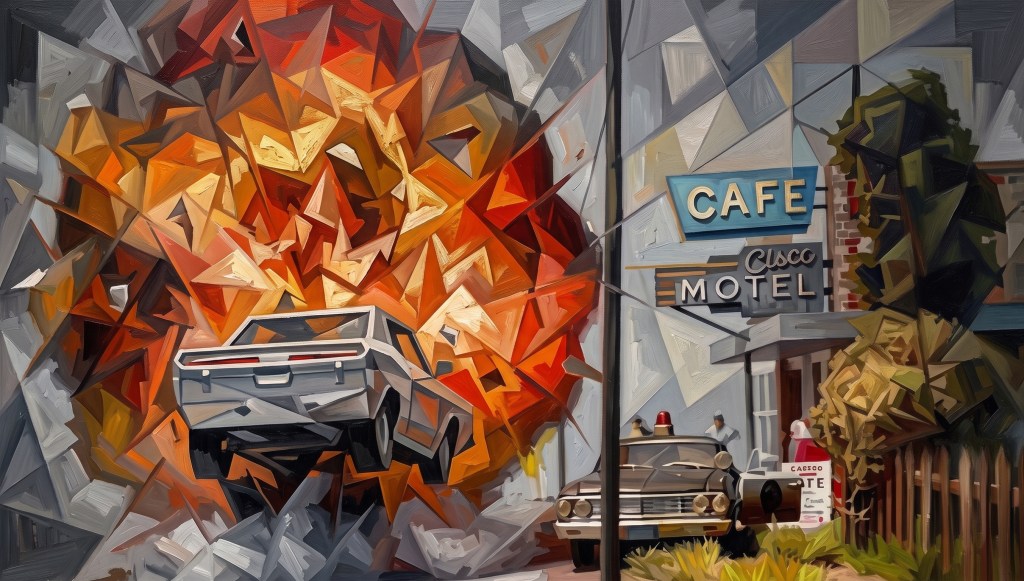
As the Cool Bus rolled east through Oklahoma along Route 66 that day, Professor T contrasted the manic bohemian hedonism of his early days with the juxtaposition of On the Road and Vanishing Point’s protagonists. Both Kerouac’s high-strung musings in the careening 1949 “Super Six” Hudson and Kowalski’s white 1970 Dodge Challenger slamming into bulldozers seemed to foretell what was to become of the crumbling “unum” in the USA’s 21st-century “e pluribus.”

NEXT WEEK:
Billie’s Albuquerque speed-bump lesson serves well as the Gang meanders around Arkansas’ hot spring destinations.

GO BACK => Preface and Chapter Links