The Chool Bus (ch32)

CHAPTER 32: The gang conducts interviews at Oklahoma State University before venturing into the hot spring paradise and pothole central of Arkansas.

Billie was glad to turn the wheel over to Buck after stopping at the National Route 66 Museum in Elk City, Oklahoma. The drive reminded her of that stretch of Interstate 70 between Abilene, Kansas, and Denver: endless prairie grass, crops, and cattle. It was a landscape mostly devoid of civilization, its boredom occasionally shattered by bus-rocking wind gusts and tumbleweed attacks. But Route 66 has a storied history, and Professor T couldn’t help thinking about the wild anecdotes Jack Kerouac included in that classic scroll known as On the Road. He (Professor T) was almost disappointed that the route couldn’t be covered on more of those two-lane stretches where Neal Cassady drove the rattlin’ Hudson like a maniac, pushing over 100 mph, passing semis on the dirt shoulder with inches to spare while talking non-stop about jazz, time, and cosmic revelations.

The trip reminded Jack Dean of those heady years when The Forks made their way around the country with their grunge-metal songs and mosh routines. They were a fairly nihilistic bunch, but not inclined to push as close to the edge as those storied Beat Poets or Gonzo Journalists of post-war America. They were mostly happy to read about the “edge” and experience it vicariously.

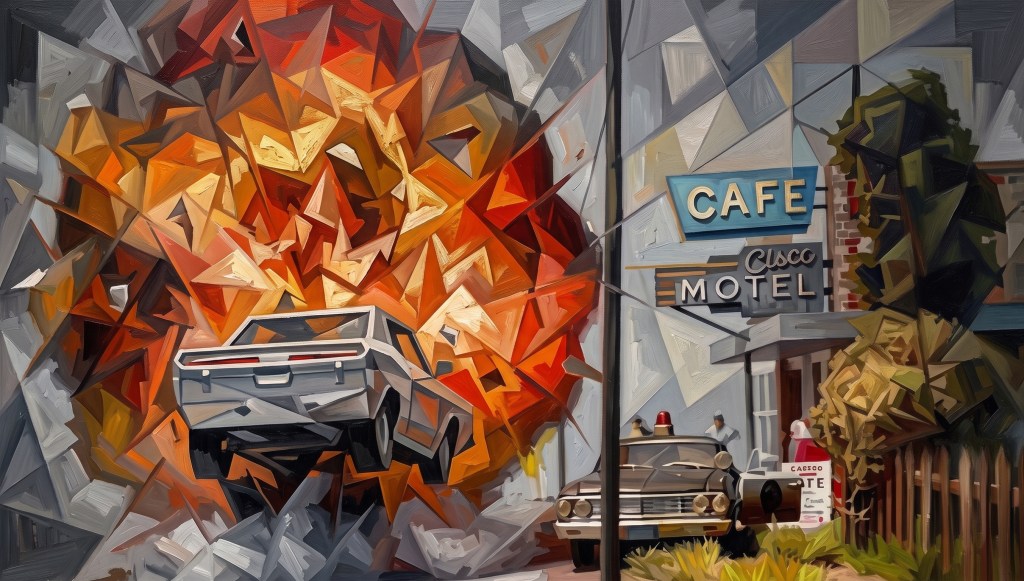
There was that wild experiment in Laramie, Wyoming, with that “Fozzy” character, but afterward, Jack was less inclined to get boosted on amphetamines and oppressive heat…sweat flying out of windshields with manic companions huddled in the backseat clutching notebooks, all convinced they were going to disintegrate into the prairie like that flash at the end of the 1971 movie Vanishing Point.

“You know, Buck,” said Jack. “Rodeo cowboys pushing their luck on raging beasts are not at all unlike the crazy beat poets, gonzo journalists, and 27-club luminaries.”

“You mean like Kerouac, Burroughs, and Hunter S Thompson? I get those references, but what’s a ’27 Club’?” Buck suspected this had something to do with Billie’s favorite rock star.

“I’m sure that ’27 Club’ syndrome correlates closely with the age at which young men finally develop some frontal lobe perspective,” said Professor T. “I haven’t really given it much thought.”

“Again with the stubborn, sexist omission of ladies as impactful human beings,” Billie said, clearly annoyed.

“Hello?” whined Buck. “What the hell is a ’27 Club’?”

Jack was the Forks’ foremost expert on nihilistic hedonism, so he took over. “Well… it’s a fairly long and sad list of beloved music artists shuffling off the mortal coil at age 27.”

“I, too, had a radical turn of karmic trajectory at that age. I can still see the scene vividly: the day i stopped chasing parties, booze, girls, and cocaine. Walking from the parking lot to my apartment after one of those pointless all-nighters, the sun blazing in my face, i was reviewing all the wasted dollars and precious time spent with people who would never be considered friends. I was 27 when i made that turn. I made it out of that phase alive… the 27 Clubbers did not.”

“Give us some names,” said Billie. “I did read about Cobain being part of something like that,” she was slowly shaking her head. “Twenty-seven is way too young for checking out.” Billie was devastated by the news of grunge’s foremost luminary.

“Okay… but it’s a long, depressing list,” said Jack. “Robert Johnson, Jim Morrison, Janis Joplin, Brian Jones, Jimi Hendrix, Amy Winehouse, and Billie’s favorite, Cobain. Neil Young once wrote, ‘It’s better to burn out than to fade away,’ and every member of the 27 Club did just that. It’s ironic Young is still with us, but as a musical journalist of sorts, i guess it’s good he survived the curse. ‘The Needle and the Damage Done’ is another example. It’s like there is a chasm across an artist’s timeline. You either have the will and ability to clear it, or you join the club. You either cross it and gain wisdom as you fade away, or you dispense all the wisdom you have by 27 and check out early.”

Rolling into Cushing Oklahoma, the scent of raw sulfur and heavy hydrocarbons wafted from the tank farms, seeping into the bus through the ventilation and cracked windows. At the fuel stop, Billie asked a local if that was normal. “Oh, that’s a good smell… means things are still hummin’ ’round here.” With a deadpan shrug while paying for her soda and candy bar, she mumbled, barely audible, “…it just smells like money to me.”

In the pre-interview discussions at OSU, Billie pressed on the unique situation Cushing residents face. She learned that despite billions of dollars in oil sloshing beneath and around the town in pipes and barrels, very little of that capital actually sticks to Main Street. Like many legacy energy hubs, the infrastructure is owned by multinational corporations, leaving the local tax base to deal with heavy road wear, crumbling asphalt, and rural infrastructure strain without a fair return.

As a consolation prize for rising to the top of the world’s natural gas producers, Cushing has become ground zero for human-induced seismic activity…the result of excessive fracking. In the 2010s, a rash of earthquakes shook the prairie, including at least one 5.0 magnitude quake that damaged historic downtown brick facades.

If that wasn’t enough, the locals live with the underlying anxiety of residing adjacent to tens of millions of barrels of volatile hydrocarbons. After all, a severe thunderstorm, lightning strike, or grass fire could ignite a biblical holocaust.

As the Cool Bus rolled east through Oklahoma along Route 66 that day, Professor T contrasted the manic bohemian hedonism of his early days with the juxtaposition of On the Road and Vanishing Point’s protagonists. Both Kerouac’s high-strung musings in the careening 1949 “Super Six” Hudson and Kowalski’s white 1970 Dodge Challenger slamming into bulldozers seemed to foretell what was to become of the crumbling “unum” in the USA’s 21st-century “e pluribus.”

NEXT WEEK:
Billie’s Albuquerque speed-bump lesson serves well as the Gang meanders around Arkansas’ hot spring destinations.

GO BACK => Preface and Chapter Links

Audiovision: Buster the MAGie

OK: Roland the Roadie, a man whose soul had been pressure-washed by the sonic assault of a hundred death metal concerts, found himself back in the beige stillness of Kansas. Because, of course. For months, his universe had been a rolling thunder-dome of Marshall stacks, sweat-soaked leather, and the high-pitched whine of a tour bus generator. But now, in the quiet, his brain kept replaying the scene from Bethel, New York. Bethel! A name that was supposed to conjure images of peace and love and naked people in the mud. Instead, it conjured for him a single, vibrating image: one deeply patchouli-soaked hippie, a walking potpourri of BO and self-righteousness, lecturing him on vibrational energies.

The whole psychic episode had left Roland feeling untethered. He decided, in a moment of profound spiritual desperation, to reconnect with the simple carpenter from Nazareth he’d learned about in Sunday School. A tune-up for the soul. The first step, apparently, was having a beer in Kanorado with an old classmate, Buster was his name, but might have been Biff or Buddy or something equally percussive.

Buster was now full-on MAGies. That’s what he called it… Make America Great In Every State! He said it with the kind of thermonuclear conviction usually reserved for multi-level marketing pitches. He was a walking, talking embodiment of the movement… a cyclone of star-spangled certainty in a Cabela’s cap. Roland, who hadn’t been inside a church since Y2K, admired the dedication. He truly did. But a few things didn’t quite add up.

“So, help me out here,” Roland began, watching the condensation snake down his bottle of suds. “Jesus was all about welcoming the stranger, the whole ‘Good Samaritan’ bit. Now, how does that square with, you know, the screaming on TV about immigrants being an invading army of… well, Bad Hombres?”

Buster took a mighty pull from his beer, his eyes gleaming with the reflected light of a flatscreen broadcasting the gospel of NewsMax. “Roly, Roly,” he said, shaking his head with a sad, paternal chuckle. “It’s an invasion. The enemy within! You gotta protect your house before you can invite people over. It’s just common sense!” Roland wondered if the biblical Good Samaritan had checked for Roman citizenship papers first.

On they went. Roland brought up humility. The washing of the feet. The first being last and the last being first. A beautiful, revolutionary kind of logic.

Buster countered with a sermon on the Prosperity Gospel. Yessir! It was a whole new, New Testament, one seemingly ghostwritten by a real estate developer from Queens. Buster spoke of the President, a man so obviously blessed that his success… the towers, the gold, the winning… was a sign of divine favor.

“It’s a blessing!” Buster roared, a bit too loudly for a Tuesday. “You model the behavior of the blessed to get blessed yourself (Because God, you see, is a big fan of winners)! Damn the torpedoes!” He finished with a belly laugh that shook the barstool.

The conversation, naturally, turned to money. Out on the prairie, a lone steer bellowed for its evening feed, a primal scream from the feedlot heartland. “It’s easier for a camel to go through the eye of a needle,” Roland quoted, “than for a rich man to enter the kingdom of God.”

Buster’s face soured. “That’s communist talk, Roly. Wealth redistribution. That’s theft. And there’s a commandment about that one, an old one. A good one.”

And so on.

Roland pivoted to peace. “Love your enemies,” he murmured. “Be peacemakers.”

“You have to crack a few eggs to make an omelet,” Buster said with a shrug, finishing his beer. “It’s a simple recipe.” Roland felt a sudden, powerful urge to test the idea on Buster’s nose, but he resisted. He had, after all, sworn off violence after the “damn hippie” pepper-spray incident.

The final frontier was Truth itself. Roland lamented a world gone funhouse-mirror mad, an upside-down where experts were fools and feelings were “alternative facts“. Buster then launched into a magnificent, thirty-minute jazz solo of pure, uncut conspiracy, a verbal firehose of YouTube links and podcast prophets about how the only way to find truth was to “do your own research.” Roland performed a quiet face-palm, a gesture of complete and utter exasperation.

“Jesus challenged worldly power,” Roland said, one last gasp. “He taught that leadership was about service, not control.”

Buster saw his opening. “Exactly! He was against the Deep State, just like us!”

Roland drained his beer. It was over. He and Buster were standing on opposite sides of a canyon, shouting into the void. They lived in two different sectors of the multiverse, occupying the same space. An irreconcilable parallax view. He realized there was no argument to be won here, only a friendship to be cautiously maintained across an ideological event horizon.

He clapped Buster on the shoulder, managed one last drop from his beer, and walked out into the vast, starry Kansas night. Roland the Roadie resolved then and there to just keep living by the simple, baffling example of the Nazarene, hoping his friend might one day meet him somewhere on the spiral of spiritual originalism.

Onward through the fog…

Audiovision: Korisne Budale!

The rusty gears of JR Murgatroyd’s consciousness ground to a halt, then lurched violently into motion. He wasn’t in Rothpal Moneybags’ tricked out, self-driving cybertruck anymore. Or, rather, he was, but also… not. The plush upholstery, once a tasteful (if conspicuously rich) Corinthian leather, now writhed with crows, each pecking at tiny, glittering golden tickets. The air, thick with the slightly sweet, “fruity” smell of leaking electrolyte chemicals and trauma, now carried a distinct whiff of… straw?

“Brain,” JR croaked, his voice a dry rasp. “Need… brain.”

He looked down. His blue power suit, once the envy of every political climber in Ohio, was now a patchwork of burlap and twine. He flapped a straw-stuffed arm. “Holy crap,” he muttered, “am i a… a scarecrow?”

A chorus of cawing erupted from the upholstery. The crows, their eyes gleaming with malicious amusement, seemed to be chanting, “Korisne Budale! Korisne Budale!”

“I resent that,” JR declared, though his voice lacked its usual conviction. “I’m a man of principles! Flexible principles, perhaps, but principles nonetheless!”

He remembered Rothpal Moneybags, the man with a glare that could curdle milk and the promises that were, upon closer inspection, suspiciously vague. “Think of the influence, JR! The access! The… the gravy!” Rothpal smarmed, his eyes glittering like a raven’s hoard. JR, ever the pragmatist, had thought, “Gravy is good. Especially when one has spent one’s formative years subsisting on… well, not gravy.”

His journey to this… scarecrow state, now a little clearer, seemed to contain the following: a wrong turn on a one-way, a frantic attempt to override the autopilot, a sudden, snap of the airbags, the sound of sirens, and then… this.

“Ah, the brain,” a tinny voice echoed. A figure, clad in gleaming tin, clanked into view. “You’re looking for one, are you? A brain? In this sector of… the multiverse?”

“Indeed,” JR said, trying to maintain a semblance of dignity while stuffed with straw. “I seem to have misplaced mine.”

The tin cyborg wannabe chuckled, a sound like nails on a chalkboard. “Misplaced? Or traded for… political advancement? Moneybags has a talent for such transactions.”

“He said it was a ‘strategic partnership’!” JR protested. “He said i was ‘instrumental’!”

“Instrumental in what? Filling his pockets while he sells fascist exceptionalism to the gullible?” The heartless Tin Man retorted. “Look around you, JR. You’re in a dimension where ‘Korisne Budale’ (useful idiot) is a viable career path.”

A yellow brick road, paved with golden tickets and broken promises, stretched into the distance. A lion, sporting a meticulously quaffed combover, cowered behind a pile of Kremlin-backed IOUs. And a witch, wearing designer yoga pants and holding a clipboard, was barking inane missives into a megaphone. “They’re grooming children! Federal workers don’t deserve a paycheck! The Gazpacho Police will throw you in the goulash!”

“This is… distressing,” JR admitted, his straw-stuffed head drooping. “I thought i was climbing. I thought i was… succeeding.”

“Succeeding at what?” The Tin Man asked. “Being a puppet? A pawn? A scarecrow with delusions of grandeur?”

“But the gravy!” JR wailed. “The gravy!”

The crows in the upholstery erupted in a fresh wave of cawing, their voices a cruel, mocking chorus. “Gravy! Gravy! Korisne Budale!”

JR, the man who once believed he could outsmart destiny, now knew the bitter truth. He wasn’t a master of his fate. He was a scarecrow, desperately seeking a brain he’d traded for a fleeting taste of gravy, in a multiverse where “win at all costs” usually meant losing everything, including your dignity. And, maybe, your actual brain.

To be continued… Rohlfie