CHAPTER 37: Sweet home Alabama
The drive from Vicksburg to Mobile was uneventful, giving Billie ample time for quiet reflection. The plan was to visit the battleship USS Alabama and the submarine USS Drum before settling into a quiet Foley RV park near Columbia Southern University, with focus-group sessions scheduled at the Orange Beach campus. Buck was keeping the road-trip tunes eclectic and interesting. But as the Chool Bus crossed into “Sweet Home Alabama,” the selection pumping out of the speakers, Werewolves of London, had a familiar ring to it. Jack was in the back of the bus struggling with why that particular song and the Welcome to Alabama sign were connected. Out of the blue, Buck piped up, “Wasn’t that song challenged for copyright by Lynyrd Skynyrd… did they win the case? If so, wouldn’t that indicate an unfair advantage for Goliath over David? In other words, copyright cases determined by whose legal team can whoop whose?”
That reminded Jack of some of the motivations behind the Creative Commons movement. “Now, CC co-founder Lawrence Lessig didn’t say that explicitly, but i agree, Werewolves of London and Sweet Home Alabama sound nothing alike despite the fact they share a common chord progression.” It was still kinda fuzzy in Jack’s memory.
“There was no copyright case,” Professor T cut in. He remembered a dust-up over Kid Rock’s appropriating Sweet Home Alabama and Werewolves of London with a thing called All Summer Long, but that case was settled by Kid’s people… getting clearance from both Zevon’s and Skynyrd’s organizations.
“Now, Zevon did seem to address a feud between Neil Young and Skynyrd back in the ’70s,” said Professor T. “It was an unflattering song about some of the Deep South’s worst history, and Young’s song, Southern Man, painted the entire region with a broad racist brush. Play It All Night Long, i believe it was called.”
None of this penetrated Billie’s silent reverie behind the wheel. She was reliving the visit to the haunted McRaven House in Vicksburg. She always felt similar to that FBI character in the TV series, X-Files. Like agent Mulder, she really wanted to believe, but there were never any solid reasons to give in. Besides, she was surrounded by academics. The Pragmatic, mildly paranoid cyber-security specialist, Jack, and the media scholar, Professor T. To convince either one of them would require a cargo-ship load of objective, verifiable evidence and replicable proofs.
But… on the one hand, Billie knows humankind doesn’t understand universal forces completely. There may be several “theory of everything” frameworks bouncing around, but Billie knows these frameworks are no different than philosophy or religion at this point. Look at quantum entanglement: particles interacting across massive distances instantly, she thought. If science can prove something that inexplicable, why is it so hard to believe that human consciousness might exist outside the body, or that there are forces, spirits, or dimensions we can’t perceive yet?
But her inner skeptic is never far, and that brought her to remember something she picked up surfing the science corners of YouTube. Human brains are hardwired pattern-recognition machines. We see faces in the dark, we misremember details to fit the stories we tell ourselves, when we’re tired or stressed, sometimes we experience sleep paralysis or auditory hallucinations. Like Professor T often reminds students, “…anecdotes aren’t data. If supernatural phenomena were real, they would be repeatable under controlled, scientific conditions. Yet, every single time a psychic or a haunted house is subjected to rigorous, double-blind testing, the spooks vanish.”
Billie’s inner dialogue was heating up. Millions of people throughout history, across completely isolated cultures, have reported ghost encounters, premonitions, and near-death experiences. Are they all just lying or hallucinating? It feels incredibly arrogant to assume humanity has the universe entirely figured out… it doesn’t. I know Jack and Mork Thompson agree about that.
Again, science requires strict, repeatable conditions, and the supernatural, by its very definition, operates outside conventional physical laws. There are no proton packs or spook traps like in the Ghostbusters movies. You can’t just trap a soul or residual energy in a containment unit. And honestly, looking at the world through a purely materialistic lens feels cold and reductive. Believing in something greater… a mystery, an afterlife, a spiritual connection… gives life a sense of wonder and meaning. It gives people hope that death isn’t just a consciousness switch flipping off forever, she thought.
Finally, the voice of Billie’s beloved father piped up, like always, to settle the matter: “Finding comfort in an idea doesn’t make it true, Billie. Wishing for an afterlife or a cosmic connection is just a coping mechanism for fear of the unknown and our own mortality.” The last time she and her father visited this topic, he told her, “Accepting the material world as it is makes life more profound, because this one is all we’ve got. Relying on supernatural explanations actually stops us from looking for real answers. Throughout history, lightning, disease, and mental illness were all blamed on gods and demons until science found the actual causes. Magic is just the placeholder we use for things we haven’t explained yet.”
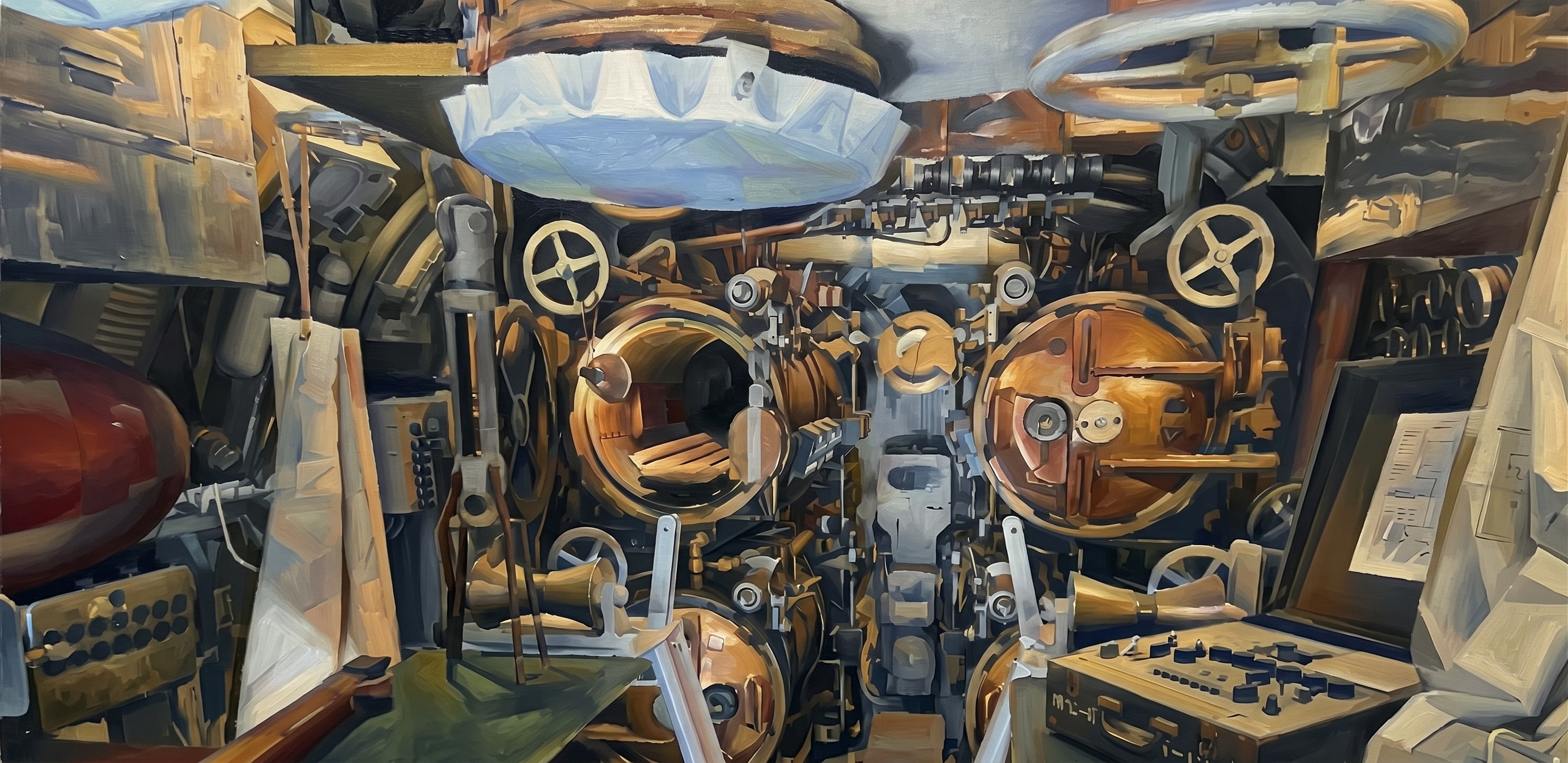
“Fine,” she whispered. And with that memory, Billie and the bus pulled into Mobile’s Battleship Parkway. Time for a walking tour of the USS Alabama and the submarine Drum.
NEXT WEEK:
Thanksgiving dinner with family in Savannah, Georgia.
GO BACK => Preface and Chapter Links


One thought on “The Chool Bus (ch37)”
Comments are closed.