The Chool Bus (ch32)

CHAPTER 32: The gang conducts interviews at Oklahoma State University before venturing into the hot spring paradise and pothole central of Arkansas.

Billie was glad to turn the wheel over to Buck after stopping at the National Route 66 Museum in Elk City, Oklahoma. The drive reminded her of that stretch of Interstate 70 between Abilene, Kansas, and Denver: endless prairie grass, crops, and cattle. It was a landscape mostly devoid of civilization, its boredom occasionally shattered by bus-rocking wind gusts and tumbleweed attacks. But Route 66 has a storied history, and Professor T couldn’t help thinking about the wild anecdotes Jack Kerouac included in that classic scroll known as On the Road. He (Professor T) was almost disappointed that the route couldn’t be covered on more of those two-lane stretches where Neal Cassady drove the rattlin’ Hudson like a maniac, pushing over 100 mph, passing semis on the dirt shoulder with inches to spare while talking non-stop about jazz, time, and cosmic revelations.

The trip reminded Jack Dean of those heady years when The Forks made their way around the country with their grunge-metal songs and mosh routines. They were a fairly nihilistic bunch, but not inclined to push as close to the edge as those storied Beat Poets or Gonzo Journalists of post-war America. They were mostly happy to read about the “edge” and experience it vicariously.

There was that wild experiment in Laramie, Wyoming, with that “Fozzy” character, but afterward, Jack was less inclined to get boosted on amphetamines and oppressive heat…sweat flying out of windshields with manic companions huddled in the backseat clutching notebooks, all convinced they were going to disintegrate into the prairie like that flash at the end of the 1971 movie Vanishing Point.

“You know, Buck,” said Jack. “Rodeo cowboys pushing their luck on raging beasts are not at all unlike the crazy beat poets, gonzo journalists, and 27-club luminaries.”

“You mean like Kerouac, Burroughs, and Hunter S Thompson? I get those references, but what’s a ’27 Club’?” Buck suspected this had something to do with Billie’s favorite rock star.

“I’m sure that ’27 Club’ syndrome correlates closely with the age at which young men finally develop some frontal lobe perspective,” said Professor T. “I haven’t really given it much thought.”

“Again with the stubborn, sexist omission of ladies as impactful human beings,” Billie said, clearly annoyed.

“Hello?” whined Buck. “What the hell is a ’27 Club’?”

Jack was the Forks’ foremost expert on nihilistic hedonism, so he took over. “Well… it’s a fairly long and sad list of beloved music artists shuffling off the mortal coil at age 27.”

“I, too, had a radical turn of karmic trajectory at that age. I can still see the scene vividly: the day i stopped chasing parties, booze, girls, and cocaine. Walking from the parking lot to my apartment after one of those pointless all-nighters, the sun blazing in my face, i was reviewing all the wasted dollars and precious time spent with people who would never be considered friends. I was 27 when i made that turn. I made it out of that phase alive… the 27 Clubbers did not.”

“Give us some names,” said Billie. “I did read about Cobain being part of something like that,” she was slowly shaking her head. “Twenty-seven is way too young for checking out.” Billie was devastated by the news of grunge’s foremost luminary.

“Okay… but it’s a long, depressing list,” said Jack. “Robert Johnson, Jim Morrison, Janis Joplin, Brian Jones, Jimi Hendrix, Amy Winehouse, and Billie’s favorite, Cobain. Neil Young once wrote, ‘It’s better to burn out than to fade away,’ and every member of the 27 Club did just that. It’s ironic Young is still with us, but as a musical journalist of sorts, i guess it’s good he survived the curse. ‘The Needle and the Damage Done’ is another example. It’s like there is a chasm across an artist’s timeline. You either have the will and ability to clear it, or you join the club. You either cross it and gain wisdom as you fade away, or you dispense all the wisdom you have by 27 and check out early.”

Rolling into Cushing Oklahoma, the scent of raw sulfur and heavy hydrocarbons wafted from the tank farms, seeping into the bus through the ventilation and cracked windows. At the fuel stop, Billie asked a local if that was normal. “Oh, that’s a good smell… means things are still hummin’ ’round here.” With a deadpan shrug while paying for her soda and candy bar, she mumbled, barely audible, “…it just smells like money to me.”

In the pre-interview discussions at OSU, Billie pressed on the unique situation Cushing residents face. She learned that despite billions of dollars in oil sloshing beneath and around the town in pipes and barrels, very little of that capital actually sticks to Main Street. Like many legacy energy hubs, the infrastructure is owned by multinational corporations, leaving the local tax base to deal with heavy road wear, crumbling asphalt, and rural infrastructure strain without a fair return.

As a consolation prize for rising to the top of the world’s natural gas producers, Cushing has become ground zero for human-induced seismic activity…the result of excessive fracking. In the 2010s, a rash of earthquakes shook the prairie, including at least one 5.0 magnitude quake that damaged historic downtown brick facades.

If that wasn’t enough, the locals live with the underlying anxiety of residing adjacent to tens of millions of barrels of volatile hydrocarbons. After all, a severe thunderstorm, lightning strike, or grass fire could ignite a biblical holocaust.

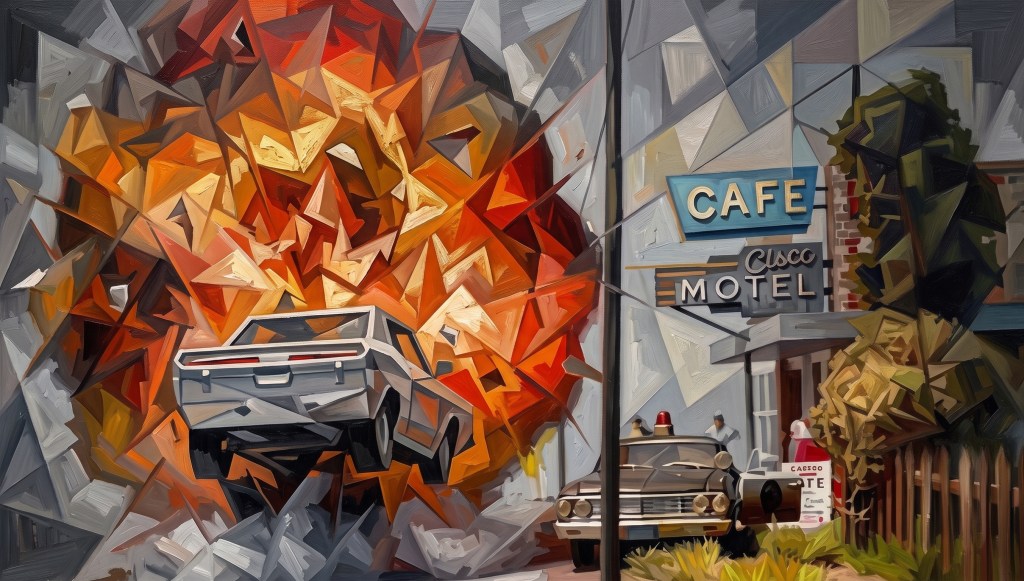
As the Cool Bus rolled east through Oklahoma along Route 66 that day, Professor T contrasted the manic bohemian hedonism of his early days with the juxtaposition of On the Road and Vanishing Point’s protagonists. Both Kerouac’s high-strung musings in the careening 1949 “Super Six” Hudson and Kowalski’s white 1970 Dodge Challenger slamming into bulldozers seemed to foretell what was to become of the crumbling “unum” in the USA’s 21st-century “e pluribus.”

NEXT WEEK:
Billie’s Albuquerque speed-bump lesson serves well as the Gang meanders around Arkansas’ hot spring destinations.

GO BACK => Preface and Chapter Links

This Land: Kansas

Howdy, loopers, gather ’round the camp fire for a full-tilt rodeo of a tale! This ain’t your typical travel brochure drivel, mind you. No sir, this is a slapstick eulogy wrapped in a fever dream, seasoned with a dash of sand and color. Strap in, because we’re headed straight for the heartland, a place some folks derisively call “flyover country.”

First things first: full disclosure. I was hatched in Goodland, Kansas, a town so small it probably has its own tumbleweed support group. My parents, bless their tragically mismatched hearts, shuffled me between this so-called “good” land and Denver as regular as school seasons. But hey, summers were spent traipsing around the glorious front range with my outdoorsy step-mom and the old man – a nature enthusiast packing enough ordinance to battle a Russian platoon. Point being, Kansas (and Colorado) are in my blood, even if it’s a tad thin on account of all shuffling.

SIDE NOTE: hereafter, we’ll refer to my stomping grounds as “Kanorado” as, in addition to all that Front Range camping, i’ve spent time schooling or gigging in almost every Western Kansas town with a school or Opera House.

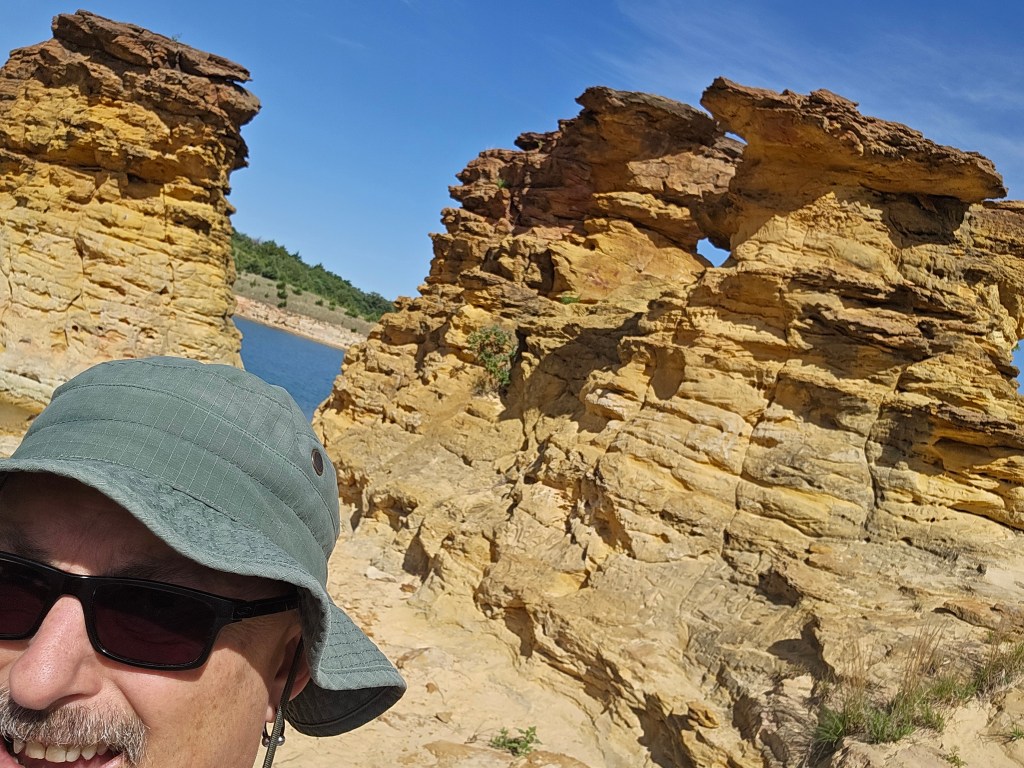
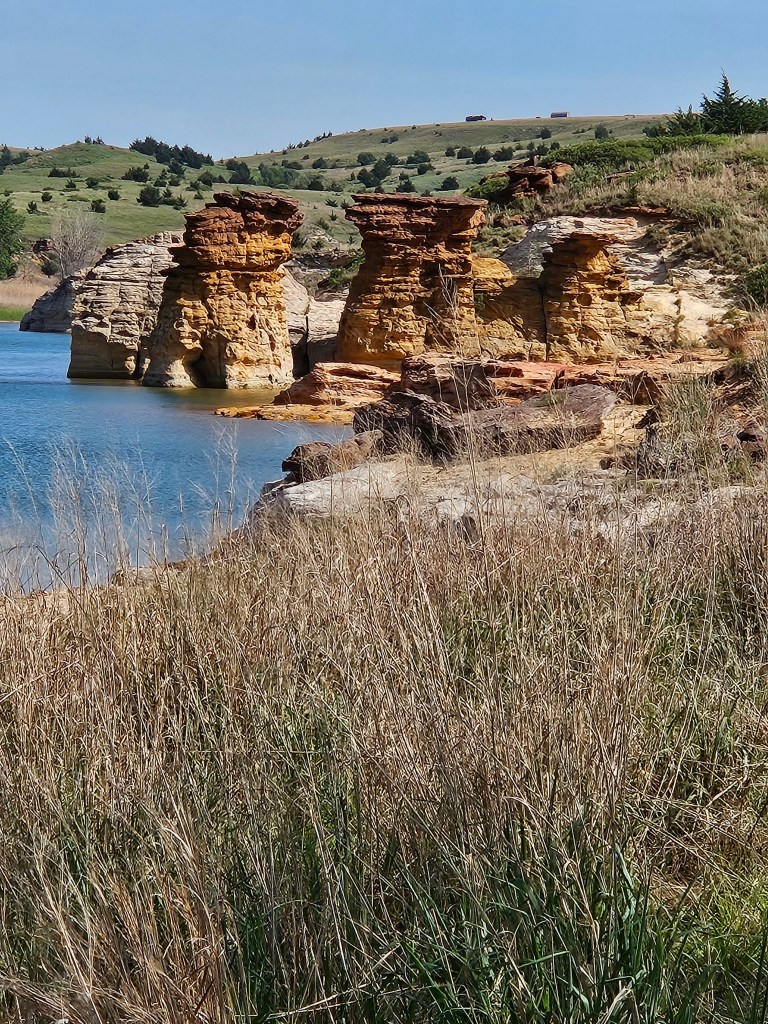
Now, some city slickers will tell you Kansas is nothing but a barren wasteland devoid of entertainment. Those sorry souls clearly haven’t bathed in the crystal-clear waters of Wilson Lake. Nestled snug against I-70 in good ol’ Bob Dole country, Wilson boasts the most transparent reservoir this side of the Missouri River, likely due to all that golden limestone chilling at the bottom. Speaking of limestone, the Rocktown trail is a naturalist’s technicolor dream – a geological wonderland teeming with flora, fauna, and rock formations that’d make Moab, Utah smile.

But hold on to your cover, loopers, because there’s more to Kansas than meets the eye. The Flint Hills, once a stomping ground for John Brown and his gorilla raiders, roll on like a never ending emerald wave. Tall tails of outlaw chicanery featuring such familiar names as Buffalo Bill Cody, Wild Bill Hickok, and Calamity Jane to name a few did at least some of their stompin’ right here in the flyover. General Dwight D., “Beware of the Military Industrial Complex,” Eisenhower from Abilene went on to kick some Nazi arse, and hey, music lovers, get this: Joe Walsh, that guitar-slingin’ jester himself, hails from Wichita!

Now, speaking of Kansas loopers, let’s get one thing straight: they’ve heard every “Wizard of Oz” joke you may have in your quiver. They won’t laugh, but they’ll wear those ruby-red kicks like a badge of honor. Now, about sports – Rock Chalk Jayhawks? Sure, they bleed crimson and blue, but they also have a healthy respect for the KCMO pro teams (GO Chiefs!). West of Wichita, however, Jayhawk fandom gets met with raised eyebrows. Many Western Kansas peeps are more partial to the Denver Donkeys. Can you believe the audacity?

Kansas City itself is a tale of two quarreling siblings. The Kansas-Missouri border rivalry stretches all the way back to the Civil War, when things got downright bloody (look up “Bloody Kansas” if you have a strong stomach). Politically, Kansas loopers tend to lean conservative, but mess with their personal liberties and you’ll see a realpolitik “don’t tread on me” spirit rise faster than a prairie dust storm. Remember that ballot initiative to control women’s bodies? Kansas loopers saw through that religious mumbo jumbo faster than a jackrabbit on a hot tin roof.

Here’s the thing about Kansas: everyone wants to claim their little town as Superman’s birthplace (Smallville), but Clark has yet to release the birth certificate so the mystery… persists. There may not be any Clark Kents out there, but there is a cause to pause, vis a vis the particular vein of grit these people exhibit. Kansas loopers are a tough lot. Most of them can drive a stick shift and have probably piloted a tractor at some point in their lives. “Home on the Range” ain’t just a song, it’s a way of life. Before corporate greed gobbled up family farms, everyone either pitched in as hired help or knew a farmer by name. Minnesota nice? Pah! Those loopers are downright chatty compared to the almost painfully polite Kansas loopers. Being the literal “heartland” of the country has its perks – neighbors here look out for each other. Need to borrow a chainsaw? No sweat. Dog gone rogue? The whole town will be on the hunt. Need a cup of sugar, or a smoky coffin nail? If they got it, you got it. Kansas loopers have a fierce sense of loyalty, that is, until karma comes knocking. They believe in what goes around comes around, faster than a tumbleweed in a tornado.

Ah, Kansas… flatter than a Baptist hymn board and about as exciting as watching paint dry? Newsflash, chuckleheads: Kansas loopers know their state’s a canvas painted in shades of endless prairie. West of Wichita, some would vote to make the telephone pole the state tree. But here’s the thing – pick a quiet spot out in the country at the “golden hour,” and you’ll be met with a spectacle that would make even God herself tip the sun bonnet. Sunsets in Kansas, loopers, are like a knife fight between angels – a Technicolor brawl that leaves the sky bruised with purples, oranges, and a fiery red that would make a MAGA hat look downright pale.

So, on to the point of this screed. To write a verse for Kansas to add to Woody Guthrie’s classic, “This Land.” I decided to dig a little deeper than a prairie pothole and get the lowdown on our state motto, “Ad Astra per Aspera” – that’s Latin for “To the stars through difficulties,” you heathens. I cornered a “student success coach” at the Kansas Wesleyan University library, and a Kansas history whiz at the Hays Public Library. Both of them, bless their unoffensive coffee mugs, talked about the state’s rough-and-tumble beginnings – the dust storms that could choke a billy goat, the grasshopper plagues that made the Bible look like a picnic. But here’s the thing: these scrappers, these pioneers with callouses on their souls, they persevered. They looked up at that endless Kansas sky, saw the Milky Way sprawled out like a cosmic wheat field, and said, “You know what? We’re going to reach for those stars, even if it means clawing our way through a mountain of misery first.”

And that, my friends, is the Kansas spirit. It’s in the way the wheat sways in the wind, a silent symphony of resilience. It’s in the way a small town pulls together after a tornado, stronger than ever. It’s in the way a Kansan, with a twinkle in their eye and a calloused hand extended, welcomes you to their state, even if you are, ahem, flyover challenged.

So, the next time you think about taking a potshot at Kansas, take a long look at a map, friend. Because out here, under skies that put on a nightly light show that would shame the Vegas Sphere, we’re reaching for the stars, one sunset at a time. And that, folks, is a beautiful thing.

And so… without further adieu, combining my personal experience, some light research queries, and my conversations with the above librarians, here’s a Kansas verse for This Land, by Woody Guthrie.

Onward through the fog… R.H.

As i was rolling…
Through the Kansas wheat fields…
I saw the Milky Way…
As a quantum field…
And though the way is…
Fraught with trouble… peril…
These folks…
Have made it to the stars!