The Chool Bus (ch38)

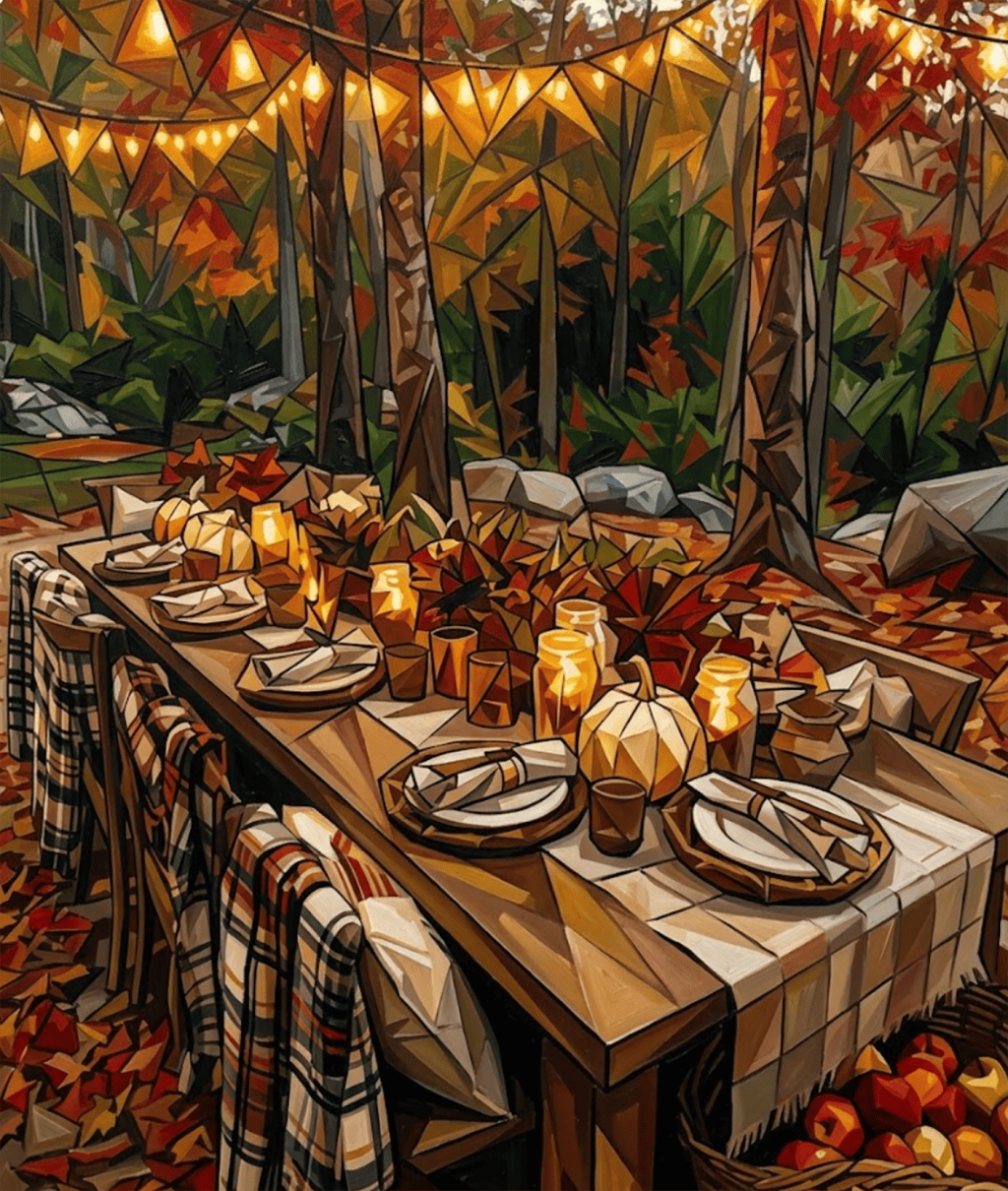
CHAPTER 38: Thanksgiving dinner with Jack’s family in Savannah, Georgia.

The house was pregnant with autumn olfactory assaults, sage, pumpkin spice, and simmering family traditions: food, spirits, and the “Scarlet P.” At one side of the long table sat Chloe, immaculate in a tailored cream turtleneck, radiating the polished, certain energy of a libertarian pundit who just signed a three-year own the libs book advance. Directly across, her favorite fightin’ cousin Jack, leaning forward in his trademark Thanksgiving navy-blue overalls, tapping his index finger trying, like always, to apply selective hearing as Chloe, grown less and less willing to leave the Scarlet P off the Thanksgiving table, droned on about unelected meddling federal bureaucrats.

Between them sat the traditional battleground: a glistening, perfectly basted twenty-pound turkey, wine, stuffing, cranberry sauce, aunts, uncles, cousins, and the Forks secretly looking forward to this legendary battle of matched wits.

The spark caught when Buck politely declined the candied yams.

“Good idea,” Jack announced, he and Buck agreed about Americans’ obsession with sugar. “No offense to Aunt Jean’s dish, but it’s always been a bit too sweet for my taste. Besides, it’s time to break the system promoting food and beverages loaded with sugar and high-fructose corn syrup to marginalized communities. Old habits die hard ya know.” Jack was waxing eloquent. “For a gustatory shock, give Japanese hard candy a try one of these days. My first exposure had me wondering… ‘where’s the sugar?’ It’s a totally different system there.”

Chloe dabbed her mouth with a cloth napkin, letting a patronizing, camera-ready smile bloom across her face. “Jack, daaarling. The only thing systemic at this table is your inability to eat a carbohydrate without turning it into a class-struggle talking-point. Are you going to debate the yams, or are you going to pass them to someone who actually believes in personal joy?”

Uncle Fred let out a low whistle from the corner. “Round one…ding, ding, ding.”

Jack didn’t miss a beat. He leaned in, his retort spinning at three hundred words per minute. “I believe in joy, Chloe. I just prefer my joy aligned with verifiable facts, preferably from recognized communities of experts, peer-reviewed, and buttressed by double-blind tests for iron-clad veracity. Speaking of credible sources, i noticed your peanut-butter pie has a store-bought crust. Don’t you usually do that from scratch? Is this your way of pulling yourself up by the bootstraps? You know that’s physically impossible, right? Try levitating the cranberry sauce over here.”

A ripple of laughter echoed down the table. Cousin Sam slapped the mahogany. “It’s true! I tried that. I put on my boots, grabbed the straps, and tried to pull myself up. Levitate…? Ha! That’s one of my favorite Dr Hook songs.”

“Sure, you got me, the crust was pre-made in a grocery store,” said Chloe. “Most likely mass produced, even. But i brought something better than homemade pie crust,” Chloe adjusted her cuffs. “I brought cash to pay for groceries. Because unlike some, whose entire ideology is dedicated to complaining about capitalism from their iPhones paid for through their parents’ family wireless plans, i actually understand market logic. Every day, i expose the hypocrisy of keyboard warriors planning revolution from their climate-controlled Brooklyn lofts.”

“Are you sure those lofts aren’t shared with three roommates because they can’t afford private housing due to venture capitalists turning the market into a casino?” Jack shot back, his hands gesturing in rapid, geometric chops. “But that’s fine. I know it’s hard for you to grasp structural inequity when your entire aesthetic is ‘I read Thomas Sowell once and made it my entire personality.’ You don’t have political philosophy, Chloe, you have a Pinterest board of 1950s tax codes.”

Aunt Jean nearly choked on her sweet tea. “Bless her heart, not the Pinterest board!”

Chloe’s eyes gleamed. She was in her element. “And your entire aesthetic is ‘I have a fancy high-tech degree and now i yell at people faster than they can blink.’ You don’t have conversations, Jack. You just have verbal seizures. If you spoke at a normal human cadence, your students would realize you’re just an over-educated shithead with a Bernie Sanders crush.”

“A fast repartee is only a seizure to someone who processes data at dial-up speeds,” Jack retorted, zeroing in. “It’s okay, take your time. I know you’re used to the teleprompter feeding you rebuttals on behalf of the billionaire class. But tell me, Chloe, when Elon finally colonizes Mars, do you think he’s gonna let you ride on the bridge, or are you gonna have to podcast from the cargo bay with the gear?”

The table erupted. Uncle Reggie had to put his fork down, laughing so hard he wheezed. “Cargo bay! He put you in the trunk, Chloe!”

Chloe broke character for a fraction of a second, a genuine smirk slipping through her practiced composure. She reached out and smoothly handed Jack the bowl of macaroni and cheese.

“Eat your dairy, Jack,” Chloe purred, her voice dripping with absolute mock-sweetness. “Your brain needs the glucose to figure out why socialism fails every single time it’s tried. Maybe you can run a quick regression analysis on the cheddar to Velveeta ratio.”

Jack accepted the bowl, scooping a generous portion onto his plate. He looked up, matching her smirk perfectly. “Thank you, Chloe. And make sure you get some of them collard greens. It’s the closest you’ll get to acknowledging your roots all year.”

The table descended into absolute pandemonium. Jimmie fell entirely out of his chair. Aunt Jean was waving a napkin in the air like a surrender flag, tears streaming down her face, while Uncle Ronnie just kept shouting, “Stop the fight! Stop the fight!”

Chloe threw her head back and let out an unpolished laugh, breaking the tension completely. She raised her crystal glass of Moscato in the direction of the turkey. Jack grinned, tapping his water glass against his fork in a mock salute. The scarlet P was put on pause, the audience was thoroughly entertained, and the gravy was finally passed.

And this scene almost didn’t happen. The Chool Bus almost didn’t make it to Georgia as circumstances began pulling on Professor T like a magnet. He needed to get back home in time to work through the sexual harassment case brought by Abigail Weiser’s corrupt attorneys. Professor T was certain all was not as it seemed, and he was determined to get to the bottom of it with what legal assistance he could afford on a mid-level academic’s salary. But Jack assured Mork the delay would be worth it as his extended family was exceedingly entertaining, especially at the annual Thanksgiving Feast.

Jack was right, and after the food and spirited debates were spent, the Forks made their way to the Bus and began the three-day journey back to home base for the holidays. Professor T was confident he would prevail in his campaign to establish innocence. If he and Abigail weren’t able to reconcile afterwards, that would be on her, he thought.

NEXT WEEK:
The Forks return home for the holidays and Professor T copes with a disappointing verdict in the troubles with Abigail Weiser.

GO BACK => Preface and Chapter Links

Audiovision: All Hail!

In the grand pantheon of Oz’s legal history, none… not the fabled Tin Man Cyborg nor the Third Goldencalf Lion… had ever ascended with the peculiar, almost manic gravitational pull of Wizard Oscar Ambrose. He was, by acclamation and political fiat, the wisest of Oz’s supreme jurists, a man sworn into office by Glinda the Good herself in a ceremony so drenched in faux-humility it bordered on the obscene. It was a spectacle of political triumph, a testament to the idea that you can, in fact, become the most celebrated arbiter of law in the land despite a childhood that read like the annotated memoirs of a sentient bruise.

Oscar was born into a family so poor it made other Oompa Loompas look like robber barons. His biological father, a man possessed of a profound and fatalistic wanderlust, had one day simply run off with the circus, taking with him a single, beverage thermos and the last shred of his dignity. His mother, a perpetually anxious woman of diminutive stature and profound despair, had subsequently crumbled under the Sisyphean pressure of being an orange woman, a role that was, in itself, a kind of oppressive agony. Young Oscar and his big sister were promptly dispatched to a foster home run by a man whose very name… Jack Ketch… was a synonym for “ragman.” He was, in a cruelty-rich land, a veritable paragon of it, and the children were subjected to a ceaseless, grinding abuse that left them with psychological scars shaped like handprints.

The world outside the foster home was no kinder. As a schoolboy, Oscar was bullied with a relentless, pathological glee for being “a little too orange”… a color-based bigotry so bizarre and yet so utterly common in Oz it was considered a conversational staple. The taunts, the shoves, the sheer, bone-deep loneliness of it all drove him to seek refuge in the Quadling Holy Order. He became an Acolyte Attendant, a kind of spiritual gofer, where the monks and nuns, for reasons entirely unrelated to charity or goodness, pushed him to strive for a kind of purified excellence. He found, in their rigid doctrine and ceaseless demands for perfection, a perfect incubator for a nascent “I’ll show them all” supervillain shoulder chip. He promised to become the very first Oompa Loompa priest.

But it was not to be. Even within the supposedly hallowed walls of the monastery, he was bullied, again for the color of his skin. His faith, a fragile thing held together with the spiritual equivalent of chewing gum and duct-tape, was crushed. He bailed, leaving behind a monastery and a God he no longer believed in, his shoulder chip now growing exponentially. The foster family, upon learning he would in fact not be the very first orange priest, exiled him with the casual cruelty of a bored farmer flicking a bug off his sleeve.

In a bizarre twist of fate… the kind of bureaucratic, affirmative action initiative so beloved by governments with a guilt complex… he was accepted into an all-Quadling private school. The bullying, a constant in his life, continued unabated, a new chorus of taunts about his skin color and his diminutive stature. But he endured. From there, he parlayed his academic prowess into a spot at Oz’s most prestigious academies of law.

Upon graduation, the big-money firms, populated by a parade of perfectly coiffed, perfectly insipid Quadling partners, rejected him. To “show them all,” he found a shorter, albeit less lucrative, path to eminence through the short line of minority hopefuls vying for powerful conservative top government posts. In the process, he came to hate these very initiatives and, more profoundly, to loathe himself for the possibility that regular Quadlings might regard him as a “welfare hire.” The thought, the gnawing, gut-wrenching possibility that they might not see him for the genius he was… that he got where he was merely because he was orange and short… was an insult so deep it became a personal mission.

And so, he set his sights on the Wizard’s office, not for the prescribed two-term maximum, but for a permanent… a lifetime appointment. His path was not without its bumps. Opponents, armed with a morbid curiosity and a penchant for the political low-blow, tried to derail his ascension by bringing some of his more peculiar personal predilections to light. They paraded his victims before the public, a gaggle of witnesses whose damning testimony was meant to destroy him. But he was a master of the turnabout. He painted himself the victim of a “high-tech lynching,” a political assassination attempt of the purest kind. It worked. “The personal,” he argued, “…must never be mixed with the political.”

And this is where his partner and intellectual north star, a woman by the name of Dorine of Omaha, emerges. Dorine, a paragon of Quadling conservative holy-warriordom, was the other half of this premier Oz power couple. On the surface, they appeared to be in lock-step with their political beliefs, but those in the know… outsiders who watched their moves with the meticulous fascination of birdwatchers… knew that she had indoctrinated him. She was the brain… he was, as a lifetime Oz supreme-jurist, the muscle, and this power couple was, in every sense of the word, at war with their political opposition.

Dorine was brought up in the plain vanilla provincialism of a small Quadling town, an environment that provided her with the kind of privilege that only the vanilla bourgeoisie could truly understand. She was a “good girl”… no mead, no poppies, just good grades and a deep, abiding sense of superiority. She was, as she liked to say, a “late-life oops,” a child born to aging parents and raised among the “Jerkers,” a group of culture warriors who believed that “politics is war.” She was, in every way, a product of her environment, one who idolized the Wicked Witch of the West and her particular brand of female disempowerment. Dorine waged a quiet but fervent war against the female autonomy movement (FAM), convinced that a woman’s rightful place was in the kitchen, churning butter and producing perfect, obedient Quadlings. At age twelve, she was already writing letters to Oz newspapers, a harbinger of the ambition, hard work, and mission-driven focus that would come to define her.

But Riviera City, a teeming metropolis of chaos and moral ambiguity, was not the best place for “good” girls. The harassments began… petty, pointless cruelties that chipped away at her carefully constructed facade. She became an angry shrinking violet, a woman whose rage was in direct inverse proportion to her confidence and agency. And so, she did what so many lost souls in Oz do… she joined a “self-help” cult. But, as cults will often do, they began the “body shaming” therapy (sans clothing), and Dorine, a woman whose every movement was driven by a deep-seated revulsion of personal over-sharing, bailed.

Like the ram-headed Ronnie Hays, when Dorine was in, she was IN. Her bag, her one and only focus, was to “destroy the enemy,” especially those who shamed her in her time of personal vulnerability. She was, and is, at war with more than half of Oz’s eligible voters. And when she met Oscar, she knew he was the man of her dreams. A fully converted Oompa Loompa! This unique combination promised to raise her social stock in a BIG way.

The pairing was perfect… he was against the universal rights movement (URM), and she was against the female autonomy movement (FAM). They were a perfect team for sticking it to the counter-culture of their formative years. And her family, a group of people whose approval was more fickle than a summer wind, decided the orange guy was okay once his opposition to the URM became apparent.

When Oscar’s bid for lifetime supreme jurist was in jeopardy due to his deep and troubling sexual perversities, her advice was simple. “This is WAR.” Duh. The nominating committee had to pay. The Ambroses made a pact… they would deny, deny, deny, and lie, lie, lie, because the ends always justify the means. And when the gods are on your side, you always double down because your cause is righteous. They played the ultimate race card… a privilege, of course, reserved only for them. “The Judge” used every tool in the book and laughed all the way to the Wizard’s throne.

The power couple’s schtick was now down to a science. Oscar must pose “above” politics, a man of profound wisdom and stoic judgment. Dorine, meanwhile, gets out there and brays their shared politics with a jumbo bullhorn, her manic talking-points designed to discredit anyone who dares oppose Oscar in the realm of Ozland power. And of course, she denies any and all conflict of interest, because a conflict of interest, like a lie, is only a problem when the gods aren’t on your side. And the gods, in their world, were definitely on their side… now and forever.