So a wise man, or a man who was at least passing for wise, started talking about truth. And the first thing he did, the clever bastard, was admit that nobody has the first clue what it is. We’re all just monkeys with car keys, little fizzing bundles of electricity piloting meat-suits around the planet, and we haven’t even figured out what the fizz is. Consciousness? Human thought? We don’t know what’s running the projector, but good lord, the movie is colorful, brief, and loud.
And yet…
Out there in the great electronic shrieking festival… pow! slap! kick! BOOM! you’ve got no shortage of bloviators, of sidewalk saviors and cable news prophets with shellacked hair, their faces glowing in the 4k pixel bath, absolutely convinced they’ve got the universe on a leash. They are selling Truth like it’s a used car, a timeless, irrefutable, low-mileage beauty that can be yours for the low, low price of your own brain. And the loudest dealership on the whole cosmic car lot is, of course, religion. These fanatics, these apostolic holy rollers with their eyes spun back in their skulls, insist their particular brand of Truth is the only one that gets you to the bliss of heaven. Just have a little faith, they say. Which is a five-dollar word for blind credulity.
And so on…
Sometimes, you see, you have to do more than just believe. Sometimes you have to get up from the couch and move your feet. Take Vlad Dracul III. There was a man who put his convictions on a stick. A very long, sharp stick. He wasn’t playing around with faith and hope. He was a man of action, a walking thunderhead of revenge. Why? Was it because the Ottoman Turks read the wrong magic book? Nope. It was because his own father traded him and his brother like hockey cards to the Sultan, who was not a nice man. It was because while Vlad III was learning to hate in a Turkish dungeon, his father and brother were being tortured and murdered by his own people.
This sort of thing can change a boy’s outlook…
Vlad’s truth wasn’t a holy whisper in his ear; it was the hot, screaming fact of betrayal, and his answer was a field outside Târgoviște decorated with two thousand screaming, writhing, shish-kabobbed exclamation points aimed at a merciless sky.
That was his dark sermon… that was his truth…
Now, let’s rewind history to Simon the Zealot, a different cat altogether. For him, the truth was a revolutionary tinderbox just waiting for a match. He saw this Jesus fellow, this Nazarene miracle man, and his synapses started to crackle with visions of Roman eagles falling out of the sky. He saw the critical mass, the juice, and he wanted to turn the power of popularity into a revolutionary battle-cry. He was trying to shove a prophet shaped like a question mark into a political hole shaped like a sword. This, you might imagine, made the local authorities a little jumpy. While Simon was trying to crown a savior king, the Romans were sharpening their nails. Was Judas the real betrayer? Or was it the man who tried to turn a movement about turning the other cheek into a bar fight with an empire? As a wise old Chinaman is supposed to have said, “If you do not change direction, you may end up where you are heading.” Simon may have changed his tactics, but his all too mortal king wound up in the same place as Vlad’s unfortunate enemies: pinned to a piece of wood, proving a point about the interaction of truth and power.
Undeniable truth? Not so fast. It’s a road, not a motel. Anyone who tells you they’ve checked in and unpacked is either running a con or they’re so lost they think the lobby is the entire universe. The best we can do is what that magnificent, gloomy German filmmaker suggests: you can actually stare into the void until misty clouds of undifferentiated nothingness take shape and stare back. Who knows? You might find something interesting in there. Mostly, you’ll just see yourself, your own egocentric story reflected in a million broken pieces. But if you can lose yourself, as the poet from Detroit once said, you might stumble over a shard of something real. Something inspiring. Just be wary the winds of power can short circuit your heartfelt illusions.
For now, until we actually begin to understand the wellspring of consciousness, could we please interrupt the merry-go-round of inherited cruelty, this endless cycle of pain passed down by people who were taught to be main characters in a story written by a mysterious, all-powerful Sky-CEO who actually cares to keep a running tab on every thought, every misdemeanor, every everything. The horror show starts when these people realize… and they usually do… that the Sky-CEO, in fact, isn’t watching and doesn’t care.
Anyway… what if we tried something else? A little compassion… a little kindness… a pinch of skepticism and doubt. After all, the points of light seen in the dark night are mostly distant clusters of billions of stars and their satellites. That the universe allows for individual micro-particles such as you, me, astrophysicists, theologians, filmmakers, schizophrenics, etc. a glimpse of itself is nothing short of miraculous. What we know (we’ve learned quite a lot over the last couple centuries) amounts to no more than a quark, on a barnacle, attached to a massive seagoing cargo barge. We’re as good as bats experiencing hearing loss, we’re constantly bumping into reality in the barely audible darkness.
But so what?
Don’t be afraid… Keep stumbling… We’ll see you there… Fishing for ecstatic truth… …in the gallery of the void.
So… here we are… in the Hays Public Library with a mission to tie the Oz parody in a bow in order to make room for the book project planned as a capstone to the Hot Springs or Busk tour. The relevant characters have been sketched… the basic outline drawn. So… i guess… without further adieu…
Audiovision: The Folly of Oz
We begin with a narrator. Picture the Twilight Zone’s Rod Serling, smoking a characteristic cigarette. Behind him, a projection screen shows stylized, harsh-lined images of a yellow brick road winding through lush green fields. He addresses his audiovision audience thusly:
“The Yellow Brick Road, they called it. A path to salvation. Hah! In Oz, all roads lead to a single, glittering lie: Riviera City, where the Wizard, a paper-tiger wrapped in loud noise, holds court.”
The narrator continues, “And so, our pilgrims gather, driven by the oldest, most pathetic of human hungers: the desire for an easy fix. There’s J.R. Murgatroyd, the Scarecrow, a poor fool who’d traded his common sense for a bowl of good-time gravy. He clutched his straw-stuffed ears between which a brain should be. He yearns for an education, for the power to understand the rigged game of Oz.”
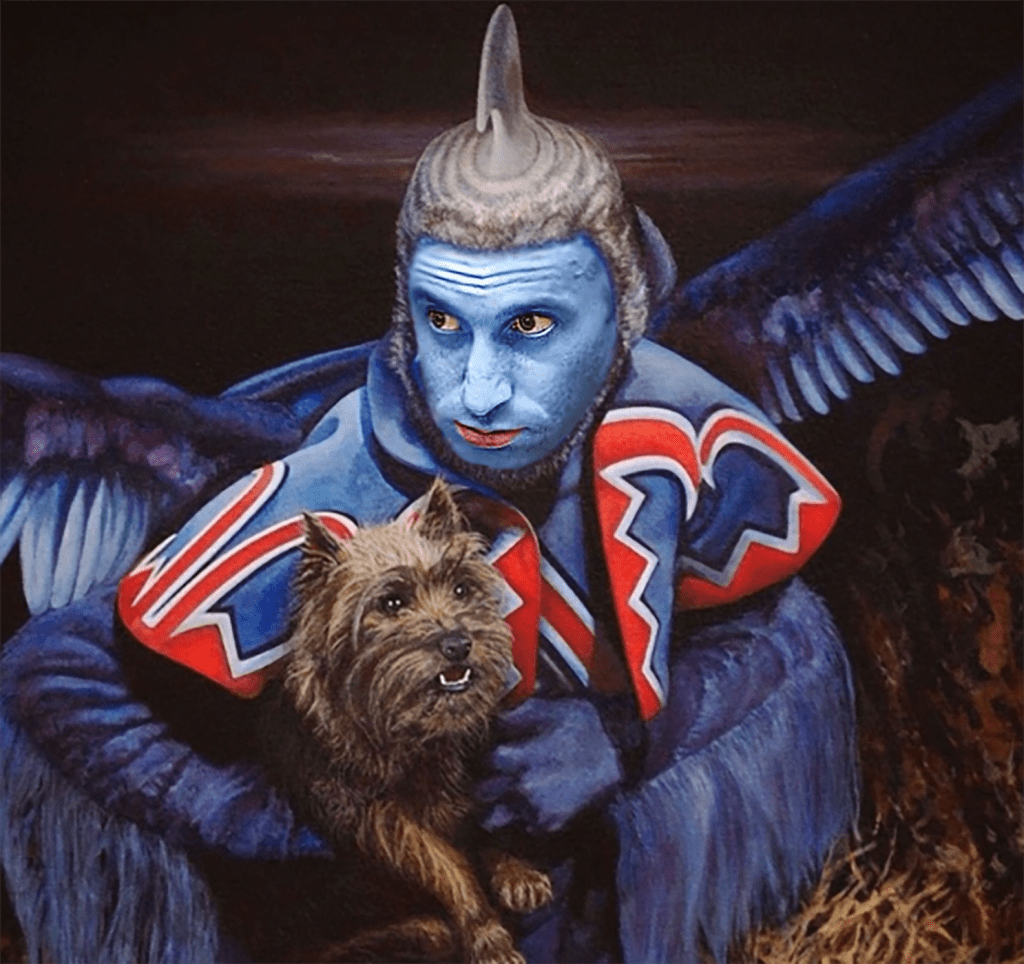
The audiovision director signals a switch to angle #2, The narrator flicks his cigarette’s ash, exhales a billowing cloud of blue smoke, looks directly into angle #2’s vision and says, “Beside J.R.,Milo Woodsman, the Tin Man, stood stiffly, a polished monument to unfeeling ambition. No heart, but a singular, cybernetic goal: to be more than flesh, to be a god in the cloud. A heart? Sentimentality! He wanted to be a cyborg, a machine of pure, cold efficiency.”
A glint in the distance as the sun rises behind shimmering Riviera City. The narrator continues, “Then, Delicate Donny Goldencalf, the Cowardly Lion. A beast of magnificent self-promotion, selling a magnificent lie. He desired a crown, a throne, a kingdom built on his own vapid image. He was the Emperor with no clothes, surrounded by sycophants who whispered, ‘Surely, this lack of character is a profound statement!’”
Presently, we hear a small dog’s bark in the distance as the narrator describes the final leg of this pilgrim’s stool, “And finally, Amelia Wolfe, the interloper from Kansas, a nurse, whose flying machine had done the world the small favor of flattening a minor Oz bureaucrat, the Wicked Witch of the West (WWW), they called her. Amelia was the unwilling participant, dragging her terrier on a frayed rope, utterly bewildered by the local legends.”
Then, from the top of the frame, a stylized puppet of Glinda the Good appears, her motions rigid and deliberate… Our narrator introduces her: “Enter Glinda the Good, Queen of the Quadlings and a master of the Persuasion Paradox. Forget your spells! Her magic was simple observation, a well-placed question, the quiet, surgical dismantling of loud, stupid arguments. She showed the pilgrims a vision in the poppy fields… a glorious battle, a hard road to the Wizard, who, she promised, held all the answers.”
And so, the setup… a real hero’s journey… a quest for truth.
But Glinda, our “Good” Witch, was engineering events and she conveniently omitted a few details. For one, Amelia Wolfe could have flown her sorry ass back to Kansas at any time. The red shoes were the key, a free ticket out of the entire mess. But Glinda needed a blunt instrument to achieve her ultimate aim, the death of the WWW, mid-level bureaucrat whose groveling to the Wizard, Oscar Ambrose, was a political liability. And who better to deliver that blow than an innocent outsider? And when the Scarecrow caught fire in the ensuing battle, Amelia, a nurse, in the process of putting out the fire, gets water on the Witch… an unfortunate coincidence, but a very tidy political assassination masquerading as a rescue mission… all engineered by Glinda.
And here is where we interrupt the narrator for a Morality Play Interjection: We see for want of a brain (Scarecrow) and the desire to help a friend (Amelia) can lead to the death of a clever operator’s inconvenient obstacle (WWW)? In Oz, good intentions are just another whammy-bar to jiggle.
So… then we cut to SCENE 2: The Wizard’s War Room…A dimly lit chamber where Oscar Ambrose, the Wizard, sits on a throne made of oversized, gilded holograph projection equipment, and Dorine of Omaha paces, her face a mask of permanent battle readiness.
Wizard Oscar speaks into a microphone, his voice echoing, distorted, and overloud. “They came for me! My opponents, armed with a morbid curiosity… a fetish, i tell you… for the personal! They paraded my dear friends and co-workers, my ‘victims,’ they said! They tried a high-tech lynching! A political assassination!”
Oscar pauses this Wizardly monolog to wipe his brow, dramatically, as Stan Diller, the Flying Monkey, creeps from behind the throne, whispers into the Wizard’s ear, then ducks away.
Oscar resumes his diatribe, his voice is suddenly flat, adopting Stan Diller’s twisted rhetoric, “The powers of the wizard… will not be questioned,” he declares pompously. “The personal… must never be mixed with the political! I am the victim here!”
Dorine of Omaha slams her fist on a small table. She wears a pin that says’: ‘DESTROY THE ENEMY.’, “The enemy,” she said. “They shamed me. They spoke of my personal vulnerability! But now, i have him! Oscar Ambrose! A fully reformed Orange Oompa Loompa!” Taking a deep breath, she bellows, “Together we will rise! Together, we will destroy them all! We are at war with the woke half of this wretched country, and we will win!”
Presently, Curtis Loki, ranking flying monkey and agent of chaos, enters, bowing low. He simps at the Wizard’s feet. “Exalted Wizard! I have invented a new doctrine! The Inherent Wizardly Prerogative! It states that whatever the Wizard does, by definition, is legal, necessary, and virtuous!”
The wizard nods vigorously, instantly adopting the new phrase.“Inherent Wizardly Prerogative! It has a good, loud ring! Loki, you’re a genius!” And as Loki was reveling in his plan coming together, Stephen K. Moros, the Winkie gatekeeper burst into the antechamber. Breaking Loki’s reverie, Moros began to shout incoherently about “Uniting the Quadlings” and the necessity of “all means necessary.” With this outburst, Oscar waved a dismissive hand.
“Too much! Too extreme, Moros! Out! I want chaos, yes, but controlled chaos. You’re making the quiet part too obnoxiously loud.” With that, Moros is escorted out and “Lindsey” O Boq of the Castleforce Guild enters bowing deeply to Dorine and then to Oscar. With a ghastly, insincere grin, he grovels at the Wizard and Dorine’s shoes. “Esteemed, magnificent leaders! My Guild, the Castleforce, is with you! Unquestionably! We support the current power. Whomever holds the big stick! We are advocates for… for power!” As he is prostrating himself, the Befuddled Witch of the East (BWE) represented by a puppet on strings glides into the room, head bowed so low it scrapes the floor.
“Oh, Great Wizard! Your every pronouncement is a diamond! Your every flick of the wrist, a symphony! I adore you! I worship your power! Your enemies are swine! I am nothing! A mere crawling servant!” And just as fast as this puppet appears, it glides back out of the room.
The narrator fades, full body, into view and briefly addresses the audiovision audience, “The machinery of power. Personal attacks become a shield. A lust for status becomes a political manifesto. And the sycophants… the Boqs and the BWE’s… they merely lubricate the machine.”
As the Wizard’s antechamber fades to black, The Scarecrow, Tin Man, Lion, and Amilia stand under a single, harsh spotlight.
J.R. Murgatroid, The Scarecrow, his voice, a plaintive wail complains, “They said Glinda was Good. She promised answers. But she sent me to a fire. I was meant to burn! And Amelia, she saved me. But to save me, she killed the WWW! I have no brain, but even i can see the algebra of it: my life for the Glinda’s convenience. The supposed good serves itself with my straw-filled body!”
Next, Milo Woodsman, the Tin Man, in a cold, metallic voice added, “Glinda presented a problem, and a solution that benefitted her. Oscar, the Wizard, simply reframes every corruption as a virtue. Amoral, efficient, both of them. One uses observation, the other uses noise. Neither cares for true justice. I seek efficiency, but this is merely a shell game of power. I still have no heart, but i believe i see how useful the idea of one is to those who wield power.”
Not to be forgotten, Delicate Donny Goldencalf, the Cowardly Lion, sobbing theatrically, puffs out his chest. “I want to be King. King of the forest! But every King in Oz, even the ‘Good’ one, must walk through the mud to get there. Glinda used a nurse! A nurse! Oscar used the personal low-blow as a stepping stone! It is all a show, a magnificent, terrifying show. Perhaps my lack of courage is simply the wisdom to see how dirty the crown truly is! But I still want it.”
Finally, Amelia Wolfe, the nurse, practical, exasperated spoke for all,“I am a nurse. I put out a fire. I saved a life. That’s my job. I didn’t intend to kill anyone. I don’t care about ‘Wizardly Prerogatives’ or ‘Persuasion Paradoxes.’ I just wanna go home. All i see is a frightened man on a loud throne, and a woman who uses people as pawns, and a political system built on deceit and noise. This Oz of yours is a sick place, and i can’t treat everyone for collective delusion! Where’s my flying machine?”
The spotlight on our pilgrims fades and the smoking narrator reappears among the surrounding darkness. Snuffing out his cigarette, he launches into an epilogue, “And there you have it… the journey continues; the Scarecrow is no closer to a brain; the Tin Man is no closer to his cybernetic godhood; the Lion is no closer to his crown; and the Nurse? She’s still stuck in the middle of a political disaster, simply because she acted on instinct. The good are not always good. The evil are not always evil. They’re all simply people, or figures, or tin, or straw, pursuing their own ambitions.” And with that, the narrator fades to black, and a panoramic shot of glittering Riviera City fades in.
And the moral of this Audiovision presentation, if you can call it that, is simple: In the end, it doesn’t matter if you are a Munchkin, a Monkey, a Nurse, or a Lion. If you stand in the way of power, or if you serve power too completely, you will be used, you will be discarded, or you will be extinguished. And the Wizard? He sits on his throne, protected by noise, protected by the same Quadlings, Gillikans, Winkies, Munchkins, and naturalized Oompa Loompas he abuses. He’s the master of the turnabout. But is he a symptom of Oz corruption, or the cause?
The panoramic shot of glittering Riviera City fades out and a single, large banner drops, bearing the stark motto: “THE POWER OF THE WIZARD… WILL NOT BE QUESTIONED!”
The rusty gears of JR Murgatroyd’s consciousness ground to a halt, then lurched violently into motion. He wasn’t in Rothpal Moneybags’ tricked out, self-driving cybertruck anymore. Or, rather, he was, but also… not. The plush upholstery, once a tasteful (if conspicuously rich) Corinthian leather, now writhed with crows, each pecking at tiny, glittering golden tickets. The air, thick with the slightly sweet, “fruity” smell of leaking electrolyte chemicals and trauma, now carried a distinct whiff of… straw?
“Brain,” JR croaked, his voice a dry rasp. “Need… brain.”
He looked down. His blue power suit, once the envy of every political climber in Ohio, was now a patchwork of burlap and twine. He flapped a straw-stuffed arm. “Holy crap,” he muttered, “am i a… a scarecrow?”
A chorus of cawing erupted from the upholstery. The crows, their eyes gleaming with malicious amusement, seemed to be chanting, “Korisne Budale! Korisne Budale!”
“I resent that,” JR declared, though his voice lacked its usual conviction.“I’m a man of principles! Flexible principles, perhaps, but principles nonetheless!”
He remembered Rothpal Moneybags, the man with a glare that could curdle milk and the promises that were, upon closer inspection, suspiciously vague. “Think of the influence, JR! The access! The… the gravy!” Rothpal smarmed, his eyes glittering like a raven’s hoard. JR, ever the pragmatist, had thought, “Gravy is good. Especially when one has spent one’s formative years subsisting on… well, not gravy.”
His journey to this… scarecrow state, now a little clearer, seemed to contain the following: a wrong turn on a one-way, a frantic attempt to override the autopilot, a sudden, snap of the airbags, the sound of sirens, and then… this.
“Ah, the brain,” a tinny voice echoed.A figure, clad in gleaming tin, clanked into view. “You’re looking for one, are you? A brain? In this sector of… the multiverse?”
“Indeed,” JR said, trying to maintain a semblance of dignity while stuffed with straw. “I seem to have misplaced mine.”
The tin cyborg wannabe chuckled, a sound like nails on a chalkboard. “Misplaced? Or traded for… political advancement? Moneybags has a talent for such transactions.”
“He said it was a ‘strategic partnership’!” JR protested. “He said i was ‘instrumental’!”
“Instrumental in what? Filling his pockets while he sells fascist exceptionalism to the gullible?” The heartless Tin Man retorted. “Look around you, JR. You’re in a dimension where ‘Korisne Budale’ (useful idiot) is a viable career path.”
A yellow brick road, paved with golden tickets and broken promises, stretched into the distance. A lion, sporting a meticulously quaffed combover, cowered behind a pile of Kremlin-backed IOUs. And a witch, wearing designer yoga pants and holding a clipboard, was barking inane missives into a megaphone. “They’re grooming children! Federal workers don’t deserve a paycheck! The Gazpacho Police will throw you in the goulash!”
“This is… distressing,” JR admitted, his straw-stuffed head drooping. “I thought i was climbing. I thought i was… succeeding.”
“Succeeding at what?” The Tin Man asked. “Being a puppet? A pawn? A scarecrow with delusions of grandeur?”
“But the gravy!” JR wailed. “The gravy!”
The crows in the upholstery erupted in a fresh wave of cawing, their voices a cruel, mocking chorus. “Gravy! Gravy! Korisne Budale!”
JR, the man who once believed he could outsmart destiny, now knew the bitter truth. He wasn’t a master of his fate. He was a scarecrow, desperately seeking a brain he’d traded for a fleeting taste of gravy, in a multiverse where “win at all costs” usually meant losing everything, including your dignity. And, maybe, your actual brain.




 Loopcircus