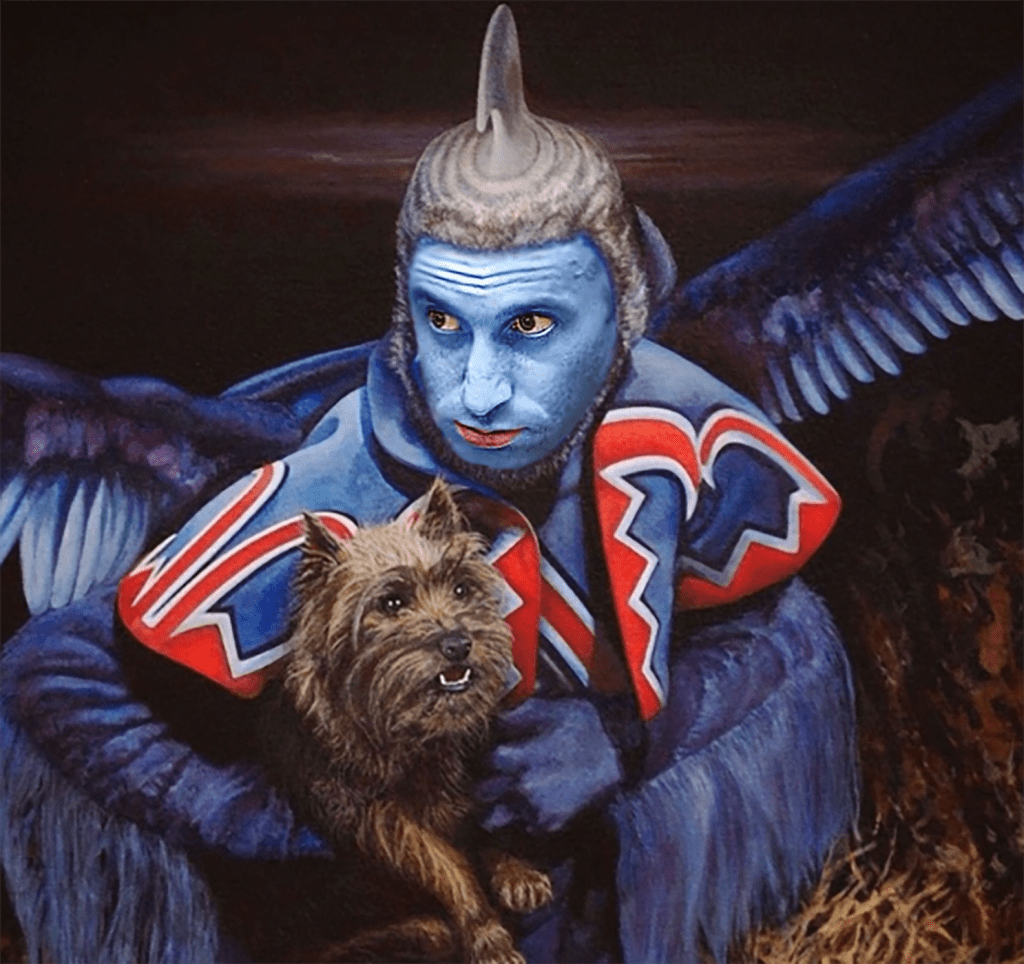
Audiovision: The Folly of Oz

So… here we are… in the Hays Public Library with a mission to tie the Oz parody in a bow in order to make room for the book project planned as a capstone to the Hot Springs or Busk tour. The relevant characters have been sketched… the basic outline drawn. So… i guess… without further adieu…

Audiovision: The Folly of Oz

We begin with a narrator. Picture the Twilight Zone’s Rod Serling, smoking a characteristic cigarette. Behind him, a projection screen shows stylized, harsh-lined images of a yellow brick road winding through lush green fields. He addresses his audiovision audience thusly

“The Yellow Brick Road, they called it. A path to salvation. Hah! In Oz, all roads lead to a single, glittering lie: Riviera City, where the Wizard, a paper-tiger wrapped in loud noise, holds court.” 

The narrator continues, “And so, our pilgrims gather, driven by the oldest, most pathetic of human hungers: the desire for an easy fix. There’s J.R. Murgatroyd, the Scarecrow, a poor fool who’d traded his common sense for a bowl of good-time gravy. He clutched his straw-stuffed ears between which a brain should be. He yearns for an education, for the power to understand the rigged game of Oz.” 

The audiovision director signals a switch to angle #2, The narrator flicks his cigarette’s ash, exhales a billowing cloud of blue smoke, looks directly into angle #2’s vision and says, “Beside J.R., Milo Woodsman, the Tin Man, stood stiffly, a polished monument to unfeeling ambition. No heart, but a singular, cybernetic goal: to be more than flesh, to be a god in the cloud. A heart? Sentimentality! He wanted to be a cyborg, a machine of pure, cold efficiency.” 

A glint in the distance as the sun rises behind shimmering Riviera City. The narrator continues, “Then, Delicate Donny Goldencalf, the Cowardly Lion. A beast of magnificent self-promotion, selling a magnificent lie. He desired a crown, a throne, a kingdom built on his own vapid image. He was the Emperor with no clothes, surrounded by sycophants who whispered, ‘Surely, this lack of character is a profound statement!’”

Presently, we hear a small dog’s bark in the distance as the narrator describes the final leg of this pilgrim’s stool, “And finally, Amelia Wolfe, the interloper from Kansas, a nurse, whose flying machine had done the world the small favor of flattening a minor Oz bureaucrat, the Wicked Witch of the West (WWW), they called her. Amelia was the unwilling participant, dragging her terrier on a frayed rope, utterly bewildered by the local legends.”

Then, from the top of the frame, a stylized puppet of Glinda the Good appears, her motions rigid and deliberate… Our narrator introduces her: “Enter Glinda the Good, Queen of the Quadlings and a master of the Persuasion Paradox. Forget your spells! Her magic was simple observation, a well-placed question, the quiet, surgical dismantling of loud, stupid arguments. She showed the pilgrims a vision in the poppy fields… a glorious battle, a hard road to the Wizard, who, she promised, held all the answers.”

And so, the setup… a real hero’s journey… a quest for truth.

But Glinda, our “Good” Witch, was engineering events and she conveniently omitted a few details. For one, Amelia Wolfe could have flown her sorry ass back to Kansas at any time. The red shoes were the key, a free ticket out of the entire mess. But Glinda needed a blunt instrument to achieve her ultimate aim, the death of the WWW, mid-level bureaucrat whose groveling to the Wizard, Oscar Ambrose, was a political liability. And who better to deliver that blow than an innocent outsider? And when the Scarecrow caught fire in the ensuing battle, Amelia, a nurse, in the process of putting out the fire, gets water on the Witch… an unfortunate coincidence, but a very tidy political assassination masquerading as a rescue mission… all engineered by Glinda.

And here is where we interrupt the narrator for a Morality Play Interjection: We see for want of a brain (Scarecrow) and the desire to help a friend (Amelia) can lead to the death of a clever operator’s inconvenient obstacle (WWW)? In Oz, good intentions are just another whammy-bar to jiggle.

So… then we cut to SCENE 2: The Wizard’s War Room A dimly lit chamber where Oscar Ambrose, the Wizard, sits on a throne made of oversized, gilded holograph projection equipment, and Dorine of Omaha paces, her face a mask of permanent battle readiness.

Wizard Oscar speaks into a microphone, his voice echoing, distorted, and overloud. “They came for me! My opponents, armed with a morbid curiosity… a fetish, i tell you… for the personal! They paraded my dear friends and co-workers, my ‘victims,’ they said! They tried a high-tech lynching! A political assassination!”

Oscar pauses this Wizardly monolog to wipe his brow, dramatically, as Stan Diller, the Flying Monkey, creeps from behind the throne, whispers into the Wizard’s ear, then ducks away.

Oscar resumes his diatribe, his voice is suddenly flat, adopting Stan Diller’s twisted rhetoric, “The powers of the wizard… will not be questioned,” he declares pompously. “The personal… must never be mixed with the political! I am the victim here!

Dorine of Omaha slams her fist on a small table. She wears a pin that says’: ‘DESTROY THE ENEMY.’, “The enemy,” she said. “They shamed me. They spoke of my personal vulnerability! But now, i have him! Oscar Ambrose! A fully reformed Orange Oompa Loompa!” Taking a deep breath, she bellows, “Together we will rise! Together, we will destroy them all! We are at war with the woke half of this wretched country, and we will win!”

Presently, Curtis Loki, ranking flying monkey and agent of chaos, enters, bowing low. He simps at the Wizard’s feet. “Exalted Wizard! I have invented a new doctrine! The Inherent Wizardly Prerogative! It states that whatever the Wizard does, by definition, is legal, necessary, and virtuous!”

The wizard nods vigorously, instantly adopting the new phrase. “Inherent Wizardly Prerogative! It has a good, loud ring! Loki, you’re a genius!” And as Loki was reveling in his plan coming together, Stephen K. Moros, the Winkie gatekeeper burst into the antechamber. Breaking Loki’s reverie, Moros began to shout incoherently about “Uniting the Quadlings” and the necessity of “all means necessary.” With this outburst, Oscar waved a dismissive hand.

“Too much! Too extreme, Moros! Out! I want chaos, yes, but controlled chaos. You’re making the quiet part too obnoxiously loud.” With that, Moros is escorted out and “Lindsey” O Boq of the Castleforce Guild enters bowing deeply to Dorine and then to Oscar. With a ghastly, insincere grin, he grovels at the Wizard and Dorine’s shoes. “Esteemed, magnificent leaders! My Guild, the Castleforce, is with you! Unquestionably! We support the current power. Whomever holds the big stick! We are advocates for… for power!” As he is prostrating himself, the Befuddled Witch of the East (BWE) represented by a puppet on strings glides into the room, head bowed so low it scrapes the floor.

“Oh, Great Wizard! Your every pronouncement is a diamond! Your every flick of the wrist, a symphony! I adore you! I worship your power! Your enemies are swine! I am nothing! A mere crawling servant!” And just as fast as this puppet appears, it glides back out of the room.

The narrator fades, full body, into view and briefly addresses the audiovision audience, “The machinery of power. Personal attacks become a shield. A lust for status becomes a political manifesto. And the sycophants… the Boqs and the BWE’s… they merely lubricate the machine.”

As the Wizard’s antechamber fades to black, The Scarecrow, Tin Man, Lion, and Amilia stand under a single, harsh spotlight.

J.R. Murgatroid, The Scarecrow, his voice, a plaintive wail complains, “They said Glinda was Good. She promised answers. But she sent me to a fire. I was meant to burn! And Amelia, she saved me. But to save me, she killed the WWW! I have no brain, but even i can see the algebra of it: my life for the Glinda’s convenience. The supposed good serves itself with my straw-filled body!”

Next, Milo Woodsman, the Tin Man, in a cold, metallic voice added, Glinda presented a problem, and a solution that benefitted her. Oscar, the Wizard, simply reframes every corruption as a virtue. Amoral, efficient, both of them. One uses observation, the other uses noise. Neither cares for true justice. I seek efficiency, but this is merely a shell game of power. I still have no heart, but i believe i see how useful the idea of one is to those who wield power.”

Not to be forgotten, Delicate Donny Goldencalf, the Cowardly Lion, sobbing theatrically, puffs out his chest. “I want to be King. King of the forest! But every King in Oz, even the ‘Good’ one, must walk through the mud to get there. Glinda used a nurse! A nurse! Oscar used the personal low-blow as a stepping stone! It is all a show, a magnificent, terrifying show. Perhaps my lack of courage is simply the wisdom to see how dirty the crown truly is! But I still want it.”

Finally, Amelia Wolfe, the nurse, practical, exasperated spoke for all, “I am a nurse. I put out a fire. I saved a life. That’s my job. I didn’t intend to kill anyone. I don’t care about ‘Wizardly Prerogatives’ or ‘Persuasion Paradoxes.’ I just wanna go home. All i see is a frightened man on a loud throne, and a woman who uses people as pawns, and a political system built on deceit and noise. This Oz of yours is a sick place, and i can’t treat everyone for collective delusion! Where’s my flying machine?”

The spotlight on our pilgrims fades and the smoking narrator reappears among the surrounding darkness. Snuffing out his cigarette, he launches into an epilogue, “And there you have it… the journey continues; the Scarecrow is no closer to a brain; the Tin Man is no closer to his cybernetic godhood; the Lion is no closer to his crown; and the Nurse? She’s still stuck in the middle of a political disaster, simply because she acted on instinct. The good are not always good. The evil are not always evil. They’re all simply people, or figures, or tin, or straw, pursuing their own ambitions.” And with that, the narrator fades to black, and a panoramic shot of glittering Riviera City fades in.

And the moral of this Audiovision presentation, if you can call it that, is simple: In the end, it doesn’t matter if you are a Munchkin, a Monkey, a Nurse, or a Lion. If you stand in the way of power, or if you serve power too completely, you will be used, you will be discarded, or you will be extinguished. And the Wizard? He sits on his throne, protected by noise, protected by the same Quadlings, Gillikans, Winkies, Munchkins, and naturalized Oompa Loompas he abuses. He’s the master of the turnabout. But is he a symptom of Oz corruption, or the cause?

The panoramic shot of glittering Riviera City fades out and a single, large banner drops, bearing the stark motto: “THE POWER OF THE WIZARD… WILL NOT BE QUESTIONED!”

Or will it…?
Who decides?

Audiovision: All Hail!

In the grand pantheon of Oz’s legal history, none… not the fabled Tin Man Cyborg nor the Third Goldencalf Lion… had ever ascended with the peculiar, almost manic gravitational pull of Wizard Oscar Ambrose. He was, by acclamation and political fiat, the wisest of Oz’s supreme jurists, a man sworn into office by Glinda the Good herself in a ceremony so drenched in faux-humility it bordered on the obscene. It was a spectacle of political triumph, a testament to the idea that you can, in fact, become the most celebrated arbiter of law in the land despite a childhood that read like the annotated memoirs of a sentient bruise.

Oscar was born into a family so poor it made other Oompa Loompas look like robber barons. His biological father, a man possessed of a profound and fatalistic wanderlust, had one day simply run off with the circus, taking with him a single, beverage thermos and the last shred of his dignity. His mother, a perpetually anxious woman of diminutive stature and profound despair, had subsequently crumbled under the Sisyphean pressure of being an orange woman, a role that was, in itself, a kind of oppressive agony. Young Oscar and his big sister were promptly dispatched to a foster home run by a man whose very name… Jack Ketch… was a synonym for “ragman.” He was, in a cruelty-rich land, a veritable paragon of it, and the children were subjected to a ceaseless, grinding abuse that left them with psychological scars shaped like handprints.

The world outside the foster home was no kinder. As a schoolboy, Oscar was bullied with a relentless, pathological glee for being “a little too orange”… a color-based bigotry so bizarre and yet so utterly common in Oz it was considered a conversational staple. The taunts, the shoves, the sheer, bone-deep loneliness of it all drove him to seek refuge in the Quadling Holy Order. He became an Acolyte Attendant, a kind of spiritual gofer, where the monks and nuns, for reasons entirely unrelated to charity or goodness, pushed him to strive for a kind of purified excellence. He found, in their rigid doctrine and ceaseless demands for perfection, a perfect incubator for a nascent “I’ll show them all” supervillain shoulder chip. He promised to become the very first Oompa Loompa priest.

But it was not to be. Even within the supposedly hallowed walls of the monastery, he was bullied, again for the color of his skin. His faith, a fragile thing held together with the spiritual equivalent of chewing gum and duct-tape, was crushed. He bailed, leaving behind a monastery and a God he no longer believed in, his shoulder chip now growing exponentially. The foster family, upon learning he would in fact not be the very first orange priest, exiled him with the casual cruelty of a bored farmer flicking a bug off his sleeve.

In a bizarre twist of fate… the kind of bureaucratic, affirmative action initiative so beloved by governments with a guilt complex… he was accepted into an all-Quadling private school. The bullying, a constant in his life, continued unabated, a new chorus of taunts about his skin color and his diminutive stature. But he endured. From there, he parlayed his academic prowess into a spot at Oz’s most prestigious academies of law.

Upon graduation, the big-money firms, populated by a parade of perfectly coiffed, perfectly insipid Quadling partners, rejected him. To “show them all,” he found a shorter, albeit less lucrative, path to eminence through the short line of minority hopefuls vying for powerful conservative top government posts. In the process, he came to hate these very initiatives and, more profoundly, to loathe himself for the possibility that regular Quadlings might regard him as a “welfare hire.” The thought, the gnawing, gut-wrenching possibility that they might not see him for the genius he was… that he got where he was merely because he was orange and short… was an insult so deep it became a personal mission.

And so, he set his sights on the Wizard’s office, not for the prescribed two-term maximum, but for a permanent… a lifetime appointment. His path was not without its bumps. Opponents, armed with a morbid curiosity and a penchant for the political low-blow, tried to derail his ascension by bringing some of his more peculiar personal predilections to light. They paraded his victims before the public, a gaggle of witnesses whose damning testimony was meant to destroy him. But he was a master of the turnabout. He painted himself the victim of a “high-tech lynching,” a political assassination attempt of the purest kind. It worked. “The personal,” he argued, “…must never be mixed with the political.”

And this is where his partner and intellectual north star, a woman by the name of Dorine of Omaha, emerges. Dorine, a paragon of Quadling conservative holy-warriordom, was the other half of this premier Oz power couple. On the surface, they appeared to be in lock-step with their political beliefs, but those in the know… outsiders who watched their moves with the meticulous fascination of birdwatchers… knew that she had indoctrinated him. She was the brain… he was, as a lifetime Oz supreme-jurist, the muscle, and this power couple was, in every sense of the word, at war with their political opposition.

Dorine was brought up in the plain vanilla provincialism of a small Quadling town, an environment that provided her with the kind of privilege that only the vanilla bourgeoisie could truly understand. She was a “good girl”… no mead, no poppies, just good grades and a deep, abiding sense of superiority. She was, as she liked to say, a “late-life oops,” a child born to aging parents and raised among the “Jerkers,” a group of culture warriors who believed that “politics is war.” She was, in every way, a product of her environment, one who idolized the Wicked Witch of the West and her particular brand of female disempowerment. Dorine waged a quiet but fervent war against the female autonomy movement (FAM), convinced that a woman’s rightful place was in the kitchen, churning butter and producing perfect, obedient Quadlings. At age twelve, she was already writing letters to Oz newspapers, a harbinger of the ambition, hard work, and mission-driven focus that would come to define her.

But Riviera City, a teeming metropolis of chaos and moral ambiguity, was not the best place for “good” girls. The harassments began… petty, pointless cruelties that chipped away at her carefully constructed facade. She became an angry shrinking violet, a woman whose rage was in direct inverse proportion to her confidence and agency. And so, she did what so many lost souls in Oz do… she joined a “self-help” cult. But, as cults will often do, they began the “body shaming” therapy (sans clothing), and Dorine, a woman whose every movement was driven by a deep-seated revulsion of personal over-sharing, bailed.

Like the ram-headed Ronnie Hays, when Dorine was in, she was IN. Her bag, her one and only focus, was to “destroy the enemy,” especially those who shamed her in her time of personal vulnerability. She was, and is, at war with more than half of Oz’s eligible voters. And when she met Oscar, she knew he was the man of her dreams. A fully converted Oompa Loompa! This unique combination promised to raise her social stock in a BIG way.

The pairing was perfect… he was against the universal rights movement (URM), and she was against the female autonomy movement (FAM). They were a perfect team for sticking it to the counter-culture of their formative years. And her family, a group of people whose approval was more fickle than a summer wind, decided the orange guy was okay once his opposition to the URM became apparent.

When Oscar’s bid for lifetime supreme jurist was in jeopardy due to his deep and troubling sexual perversities, her advice was simple. “This is WAR.” Duh. The nominating committee had to pay. The Ambroses made a pact… they would deny, deny, deny, and lie, lie, lie, because the ends always justify the means. And when the gods are on your side, you always double down because your cause is righteous. They played the ultimate race card… a privilege, of course, reserved only for them. “The Judge” used every tool in the book and laughed all the way to the Wizard’s throne.

The power couple’s schtick was now down to a science. Oscar must pose “above” politics, a man of profound wisdom and stoic judgment. Dorine, meanwhile, gets out there and brays their shared politics with a jumbo bullhorn, her manic talking-points designed to discredit anyone who dares oppose Oscar in the realm of Ozland power. And of course, she denies any and all conflict of interest, because a conflict of interest, like a lie, is only a problem when the gods aren’t on your side. And the gods, in their world, were definitely on their side… now and forever.

Audiovision: Glinda the Good

The word came down from the Tower of Smoke and Mirrors like a week-old tornado warning! Glinda the Good, that shimmering, pastel-drenched enigma whose public persona suggested a diet of spun sugar and unwavering good will, had landed herself a lifetime gig in the judicial system of Oz. Permanent. Locked in tighter than a Winkie guard’s sphincter at a tactics and control seminar. The Wizard, bless his holographic heart, figured she was a sure bet, a pre-packaged yes-woman bobbing along on her iridescent bubble, ready to rubber-stamp whatever flimsy decree wafted down from his lofty, smoke-filled cranium. He envisioned compliant nods and sparkling affirmations. What he got was a freakin’ constitutional originalist.

The first seismic tremor registered not on the Richter scale, but in the Oz Toot-sphere, that swirling cesspool of gossip and digital bile. A post, brutal in its unflattering candor captured mid-mastication on a truly formidable ripe yellow elongated berry-fruit, courtesy of the local trading post no doubt. The toot declared in no uncertain terms: “She’s a big problem!” One hundred and seventeen thousand-plus digital thumbs-up slammed into that poor banana, a collective grunt of outrage echoing across the digital plains. Initially, one might peg this as the handiwork of the Quadling Liberation Front, those tireless advocates for opening Oz’s borders to every Tom, Dick, and Kansas refugee with a hard-luck story. But no, this particular broadside originated from the very heart of the Wizard’s support base, the frothing legions of tin-foil hat keyboard warriors. Glinda’s transgression? A simple, yet devastating, vote to allow two billion gold coins poured into the Outer-Realm black hole. O-Z-A-I-D, for Christ’s sake… to some nebulous, faraway land that wouldn’t know a Poppy Field from a peyote button. The outrage was palpable, thick enough to choke a gaggle of giggling Munchkins.

Then came the inevitable chorus of “diversity appointment” accusations, a low, guttural moan that swiftly escalated into a full-bore demand for Glinda’s immediate and public immolation. Glinda, bless her pastel-hued soul, merely blinked. She understood the Oz vernacular all too well. Diversity appointment was simply the contemporary euphemism for anyone who didn’t enthusiastically sign onto their perpetually expanding list of grievances. The Befuddled Witch of the East, a creature whose default setting was apoplectic rage, even managed a semi-coherent screed opposing the aid, though her reasoning remained, as always, lost somewhere in the dense fog of her own bewilderment.

But here’s where the plot thickens, loopers, like a cauldron full of ill-conceived witch’s brew. A deep dive into Glinda’s magical rap sheet revealed a rather inconvenient truth for both sides of the Oz divide. The notion that she was some secret weapon of the Progressive lobby was pure, unadulterated fantasy. Nor was she some knee-jerk anti-Wizard revolutionary, itching to dismantle his flimsy empire of illusion. Case in point: her staunch defense of the Wizard’s “Official Oz Legal” immunity, a loophole wide enough to drive a fleet of Winged Monkeys through, protecting his every questionable act committed under the banner of “governance.”

No, Glinda, it turned out, was a far more insidious beast. She was a disciple of the “persuasion paradox.” Forget your ancient spells and dusty grimoires, this was a weapon forged in the fires of pure, unadulterated observation. Watch. Listen. Ask questions. Argue less. Persuade more. It was the antithesis of everything Oz stood for, a land where political discourse generally involved escalating decibel levels, launching personal attacks with the accuracy of a drunken Monkey, and, when all else failed, unleashing the aforementioned simian hordes.

Her most audacious deployment of this insidious tactic came during the Great Ruby Slipper Debacle. Some wide-eyed innocent from Kansas, whose flying contraption had inconveniently pancaked the Wizard’s favorite Western Witch, was in possession of the coveted foot wear. The Wizard, ever the pragmatist when it came to optics and power consolidation, wanted those slippers. Badly. His master plan involved Glinda snatching them and handing them over to the Befuddled Witch of the East (BWE), a transparent attempt to appease the increasingly unruly Eastern provinces. But Glinda, that quiet operator, had been watching. She’d listened to the girl’s simple, desperate longing for that flat, desolate landscape called “home.” And instead of engaging in the usual Oz screaming match with the Wizard, she simply started asking questions. Deceptively simple questions about the true nature of power, the purpose of magic beyond political maneuvering, and the fundamental need for belonging that resonated even in a bewildered Kansan. She didn’t argue. She didn’t counter. She simply… guided. And like a whisper in a hurricane, she prevailed. The slippers stayed put, the girl and her mangy mutt skipped back to Kansas, a refugee crisis averted by the gentle, almost imperceptible, force of quiet persuasion.

And so Glinda watched the latest digital lynching party unfold on the Toot-sphere, a barely perceptible smirk twitching at the corner of her lips. Let them rage. Let them post their tiny digital toots until their fingers bleed. She would, in her own unsettling, deeply humane way, continue to win. She would observe, she would listen, she would ask, and she would quietly, irrevocably, prevail. The swirling, chaotic vortex of Oz politics, a Category 5 shitstorm of epic proportions, would simply spin around her, the eye of the hurricane, a place of unsettling calm.

Stay tuned, loopers! The Yellow Brick Road is paved with broken promises and the occasional well-aimed banana. And Glinda? Well, Glinda is just getting started. The Oz citizens know it. And somewhere, deep in Riviera City, so does the Wizard. He just hasn’t quite figured out why yet.

Audiovision: You Can Run…

The wind carried a faint scent of desperation and bruised fruit through the dusty antechamber, a space where grand pronouncements went to fester amongst discarded banana peels and mango pits. Here Curtis Loki, a simian with a spiffy vest and eyes hinting a few gears shy of full-blown psychopathy, laid his grand designs before the Wizard of Oz.

The Wizard… a man whose booming voice couldn’t quite mask the tremor of age and whose dramatic flair usually landed somewhere between impressive and vaguely menacing, reclined on a leather captain’s chair, a gift from a prominent Oz lobbyist. He sipped tea, courtesy of the perpetually twitchy Castleforce Guild leader and listened with an air of bored indulgence to Loki’s manic pronouncements.

Loki, all frantic monkey paw-wringing and self-important chest puffs, unveiled his masterpiece: the “Doctrine of Inherent Wizardly Prerogative.” It was a deliciously simple concept, dripping with the kind of logic only a megalomaniacal monkey could concoct. True governance, he argued, sprang solely from the Wizard’s “divinely-inspired” (a phrase Loki lingered on with sycophantic relish) mind. All that tedious business of elections and public sentiment? Mere distractions. Like shiny pebbles to a flock of easily-amused working-class munchkins, winkies… and quadlings.

The Wizard, whose patience for town hall meetings was non-existent, lapped it up. No more endless debates about the poppy trade? No more agonizing over the precise shade of yellow for that infernal brick road? The prospect was intoxicating. Good Witch Glinda, with her tiresome insistence on “the will of the people,” suddenly seemed as appealing as week-old guacamole.

Loki, sensing the hook firmly set, elaborated. First, a subtle campaign of disinformation against those pesky elected munchkin, winkie, and quadling officials – whispers of poppy crop hoarding and an unhealthy fixation on blingy stones. Then, “streamlining initiatives”: petitions on enchanted parchment only the Wizard could decipher, town hall meetings atop Unclimbable Mountains, voting booths guarded by creatures whose temperament matched their sharp claws. The Wizard chuckled, a wheezing sound that promised impending doom. “Devilishly clever, Curtis!”

Finally, when the inevitable bleating of the disenfranchised masses arose, the flying monkeys, Loki’s nominal command, would “encourage compliance” with persuasive aerial maneuvers and, the pièce de résistance, strategically deployed protester blacklists. The details, Loki waved off, would bloom in the “glorious theatre of conflict.” From the next room, the Befuddled Witch of the East (BWE), a creature defined by confused chirps and water phobia, mumbled something about restless winkies.

In the throne room, amidst the Wizard’s smoky, slightly threadbare projection, the doctrine was unveiled. The munchkins, winkies, and quadlings, a motley crew easily bewildered by anything more complex than a freshly polished coin, listened with growing unease. Loki, perched beside the shimmering visage of the Wizard, radiated officious self-importance. When a brave munchkin dared to inquire about their recently elected Poppy Distribution representative, Loki smoothly dismissed him. “The power of the Wizard will not be questioned!” Doubt, he declared, was the rust of progress.

A winkie mentioned the existing “Charter of Oz”. Loki scoffed. A “quaint historical document,” a “preliminary sketch” awaiting the Wizard’s glorious final brushstrokes. The Wizard’s projection beamed, oblivious to the rising tide of bewildered resentment. “Embrace the Loki Doctrine,” he bellowed!

Then, Glinda’s voice, clear and sharp, cut through the smoky air. “Oh dear. It seems someone has been reading too many pamphlets on ‘How to Subvert Democracy for Dummies.’” The audacity, she implied, was truly breathtaking. Loki paled. The Wizard’s projected face wobbled.

In the ensuing chaos, as the assembly began to murmur and regard the flying monkeys with newfound suspicion, Loki knew his window was closing faster than a winkie’s eyelid in a dust storm.

Back in the increasingly chaotic antechamber, littered with stray feathers and overturned furniture, Loki stuffed pilfered blingy stones and suspiciously shiny adornments into a small satchel. “Strategic repositioning,” he muttered. The glorious chaos having arrived, though not quite as he’d envisioned.

The Wizard burst in, looking crestfallen and thoroughly put out. Tomatoes, overripe ones at that, had been hurled at his projection. Glinda was being sweetly reasonable, droning on about fundamental rights. Meanwhile Loki feigning concern, suggested a tactical retreat to preserve the Wizard’s “magnificent aura.”

“But, but, but… my absolute power!” the Wizard wailed.

Loki, patted the Wizard’s arm condescendingly. Power was fluid, he explained. Sometimes, a cunning individual needed to let the turbulence subside, a new power vacuum to form. And who better to fill it than a seasoned advisor with a name that had a certain… ring to it? He glanced meaningfully at his bulging satchel..

Suspicion finally dawned in the Wizard’s bewildered eyes. “Curtis… are those my spare emerald cufflinks?”

“I saved them for you!” Loki chirped, just as a gaggle of singed and furious flying monkeys stormed in. Promises of fermented mango juice had yielded only angry prohibitionists and a lecture on temperance from Glinda. Loyalty, it seemed, had its limits, especially when faced with ripe projectiles.

“Loki!” they shrieked, advancing menacingly.

The Wizard pointed a trembling finger. “You were using me! This whole ridiculous ‘inherent prerogative’ BS was a ruse!”

Loki grinned sheepishly. He knew the jig was up. “All’s fair,” he quipped, “in love and the overthrow of democratically elected swamp critters. Besides, think of the legend! Curtis Loki, the monkey who almost…”

His voice faded into the chaos as flying monkeys descended in a flurry of feathers and angry chitters. The Wizard watched, a morbid fascination replacing his outrage. From the next room, the BWE’s voice surprisingly lucid, drifted in, complaining about the recent surge of migrant Oompa Loompas.

The lights faded on the sounds of simian squabbling and the Wizard’s bewildered sighs. The Loki Doctrine, born of manic ambition and a surprising taste in spiffy vests, had imploded. The game, as Loki had craved, had indeed begun, though he now found himself firmly on the receiving end of its brutal, sticky consequences. For now, at least. A monkey with a taste for power rarely stays down for long.

Stay tuned… to be continued.

Audiovision: Who Dares?

Lindsey Boq was admiring Riviera City’s shimmering skyline in the summer heat, when a voice like a Carnyx came. “Boq, get your ass to the Riviera Gate. Stephen K. Moros is loose again. And the Wizard’s campaign is hemorrhaging Oz bucks faster than a Munchkin after a night of bad poppy-field wine.”

The whole scene was a goddamn circus. The air, thick with the stench of fear and burnt toast, buzzed with the frantic energy of a thousand Quadling Scouts gone mad. And in the center of it all, like a particularly odious toadstool in a field of poisonous mushrooms, was Stephen K. Moros.

This wasn’t some two-bit grifter peddling snake oil to the Gillikins. This was the man who, they say, earned his city planning degree and a frickin’ Castle Guard fur hat before seeing the light… or maybe just the dark, twisted underbelly… of the whole Oz Kingdom. He started as a loyal Oz Youth, a card-carrying member of the establishment, until a botched operation by the Winkie guards (oh-ee-oh, yo-ho, indeed) flipped a switch in his brain. He went from loyal lapdog to a full-blown, anti-establishment zealot… a secret rebel with a sneer and a plan to burn the whole rotten system down.

His first move, a brilliant stroke of pure, unadulterated cynicism, was to get in bed with the BWE’s conspirators on the castle wall and make a killing on poppy futures. Insiders. Trading. The man was a financial genius, but not the kind the Wizard of Oz would want to see on his campaign posters. With a bulging sack of gold, he was free. Free to unleash a storm of Molotov cocktails, first against the Gillikins, then against anyone who had the gall to defend them. He wasn’t subtle about it either. He called the Gillikins “something much darker” than the BWE and her Flying Monkeys. Even Boq, who’s no slouch when it comes to bomb-throwing, said he (Moros) was a bully who’d sell out his own allies just to back another bully, The Wizard.

Moros saw the BWE’s cult for what it was… a seething cauldron of “rootless white Quadlings” with “monster power.” He saw an army, a horde of flying monkeys and Quadling trolls who would come pouring in through the Riviera Gate, “turned onto politics and The Wizard.” He understood the dark magic of demagoguery, the power of fear and hate to bind a mob together.

The man wasn’t just a political hooligan, though. He was also director of Oz-sphere2, some closed ecological system experiment that was supposed to help Winkies live in outer space. But under Moros, it turned into an exercise in pure, self-serving, anti-science madness, shifting its focus to obfuscating Oz’s environment and pollution data, all to serve his own twisted agenda.

He rode The Wizard’s coattails, spreading fake news and half-truths, a one-man disinformation campaign. His reign of terror ended, as these things often do, in a firestorm of his own making. A “Unite the Quadlings” rally went sideways, turning into a riot, and the blame… “many sides,” they said… came straight from Moros himself. The Riviera City representatives, not known for their bravery, even put out a statement calling on The Wizard to fire this “well-known Quadling supremacist leader.”

And what did Moros do? The moment The Wizard threw him to the wolves, he turned on his former boss, calling him a “crooked business guy” and “just another scumbag.” He was pure Machiavelli, a man who saw no loyalty, only opportunity. The word on the street was that he saw the BWE as a fellow nationalist, a kindred spirit in the crusade against cosmopolitanism.

His end, for a time anyway, was ignominious. Arrested for conspiracy to commit fraud and money laundering connected to the Oz Wall fundraising campaign. He pleaded guilty, got a slap on the wrist… three years of conditional discharge, but his luck ran out. The Oz Supreme Court laughed his appeal out of court, and he found himself in a federal prison for a year, a caged beast.

Now, he’s back, a little grayer, a lot crazier. He’s got a new obsession, a new target for his rhetorical Molotov cocktails: magic and anti-science. He’s proud to be an Oz Luddite, preaching against artificial intelligence and other new technologies, terrified that the Winkie guards might one day be replaced by some soulless machine. He’s a man fighting yesterday’s wars, a dinosaur roaring at the meteor, but a dangerous one all the same. The circus is back in town, and Stephen K. Moros is still the main attraction. And somewhere, we can hear a low, familiar growl “oh-ee-oh, yo ho!”

Wizard Whisperer

By the smoking shrooms of the Riviera City, what fresh hell is this? Stan Diller, they call him. Diller Monkey, the festering boil on the backside of Oz. This ain’t your cuddly winged primate flinging feces for giggles, no sir. This is a creature brewed in the very cauldron of Quadling nationalist bile, a walking, squawking hate-balloon who somehow, by the grace of some seriously twisted karmic joke, has the ear – and apparently the drooling attention span – of the goddamn Wizard.

They gossip, these nervous little Munchkin handlers with their sweaty palms and darting eyes, that Diller is the “Wizard Whisperer!” More like the Wizard’s ventriloquist, shoving his twisted rhetoric up the old man’s puppet-hole while the Wiz just blinks and nods like a wind-up jack-in-the-box. Remember that fiasco at the Castleforce Guild global summit? Poor Wizard, nodding off like a goddamn used car lot inflatable tube-man gone limp, and there’s Diller, his beady little monkey eyes gleaming with some kind of perverse pride, practically dragging the befuddled old coot out by the sleeve. You’d almost feel sorry for the Wizard, if you weren’t so busy choking on the stench of Diller’s racist policies.

Family separation at the border? “Zero tolerance” for anyone who doesn’t sport pristine Quadling papers? Banning Oompa Loompas? This is pure, uncut Diller Monkey madness, a xenophobic freak show orchestrated by a tiny, bitter primate with a heart full of rusty nails and a brain marinated in White Quadling grievance. All the more puzzling is the fact that Diller is a flying monkey. A race of creatures formerly demonized and nearly exterminated by the very Quadlings he currently champions. Irony, apparently died in the realm years ago. And the Wizard, bless his fading faculties, scarfs it up like a Big Mac and large fries.

“A simple, no-brainer,” Diller chirps, regarding the trauma inflicted on families ripped apart at his command. This is the kind of soulless pronouncement that should send a chill down the spine of every sentient creature in this cursed land. “The powers of the wizard… will not be questioned!” he screeches, his voice echoing with the unmistakable timbre of a tinpot dictator in the making. Familiar, you say? You bet your lollypop stick it’s familiar. It’s the sound of freedom getting a fake-news red pill shoved up its bum.

And the literary tastes of this creature? Mourning the loss of some scribbler peddling White Quadling “genocide” fantasies in the pages of “Blackheart,” that festering rag for the Oz alt-right? Of course he did. Because this isn’t about policy for the common good, loopers. This is about the primal, gut-level ugliness of racial animus, plain and simple. Diller Monkey isn’t interested in making Oz great again. He’s interested in making it “white” again. Whatever the hell that means in a land full of tin woodsmen, upright lions, and talking scarecrows.

So here we are… the Wizard, the once-revered reality-TV star, now a doddering puppet dancing to the tune of a racist little monkey. The citizens voted for a Wizard, but what they got was Diller, the “Wizard Whisperer,” the architect of Oz’s slow, agonizing descent into a xenophobic hellhole. And all we can do is show up, amidst the crumbling grandeur of Riviera City, and rage against the machine. Because in the grand, twisted theatre of Oz, that’s the only goddamn sane response left.

Stay tuned… much more to come.