So… here we are… in the Hays Public Library with a mission to tie the Oz parody in a bow in order to make room for the book project planned as a capstone to the Hot Springs or Busk tour. The relevant characters have been sketched… the basic outline drawn. So… i guess… without further adieu…
Audiovision: The Folly of Oz
We begin with a narrator. Picture the Twilight Zone’s Rod Serling, smoking a characteristic cigarette. Behind him, a projection screen shows stylized, harsh-lined images of a yellow brick road winding through lush green fields. He addresses his audiovision audience thusly:
“The Yellow Brick Road, they called it. A path to salvation. Hah! In Oz, all roads lead to a single, glittering lie: Riviera City, where the Wizard, a paper-tiger wrapped in loud noise, holds court.”
The narrator continues, “And so, our pilgrims gather, driven by the oldest, most pathetic of human hungers: the desire for an easy fix. There’s J.R. Murgatroyd, the Scarecrow, a poor fool who’d traded his common sense for a bowl of good-time gravy. He clutched his straw-stuffed ears between which a brain should be. He yearns for an education, for the power to understand the rigged game of Oz.”
The audiovision director signals a switch to angle #2, The narrator flicks his cigarette’s ash, exhales a billowing cloud of blue smoke, looks directly into angle #2’s vision and says, “Beside J.R., Milo Woodsman, the Tin Man, stood stiffly, a polished monument to unfeeling ambition. No heart, but a singular, cybernetic goal: to be more than flesh, to be a god in the cloud. A heart? Sentimentality! He wanted to be a cyborg, a machine of pure, cold efficiency.”
A glint in the distance as the sun rises behind shimmering Riviera City. The narrator continues, “Then, Delicate Donny Goldencalf, the Cowardly Lion. A beast of magnificent self-promotion, selling a magnificent lie. He desired a crown, a throne, a kingdom built on his own vapid image. He was the Emperor with no clothes, surrounded by sycophants who whispered, ‘Surely, this lack of character is a profound statement!’”
Presently, we hear a small dog’s bark in the distance as the narrator describes the final leg of this pilgrim’s stool, “And finally, Amelia Wolfe, the interloper from Kansas, a nurse, whose flying machine had done the world the small favor of flattening a minor Oz bureaucrat, the Wicked Witch of the West (WWW), they called her. Amelia was the unwilling participant, dragging her terrier on a frayed rope, utterly bewildered by the local legends.”
Then, from the top of the frame, a stylized puppet of Glinda the Good appears, her motions rigid and deliberate… Our narrator introduces her: “Enter Glinda the Good, Queen of the Quadlings and a master of the Persuasion Paradox. Forget your spells! Her magic was simple observation, a well-placed question, the quiet, surgical dismantling of loud, stupid arguments. She showed the pilgrims a vision in the poppy fields… a glorious battle, a hard road to the Wizard, who, she promised, held all the answers.”
And so, the setup… a real hero’s journey… a quest for truth.
But Glinda, our “Good” Witch, was engineering events and she conveniently omitted a few details. For one, Amelia Wolfe could have flown her sorry ass back to Kansas at any time. The red shoes were the key, a free ticket out of the entire mess. But Glinda needed a blunt instrument to achieve her ultimate aim, the death of the WWW, mid-level bureaucrat whose groveling to the Wizard, Oscar Ambrose, was a political liability. And who better to deliver that blow than an innocent outsider? And when the Scarecrow caught fire in the ensuing battle, Amelia, a nurse, in the process of putting out the fire, gets water on the Witch… an unfortunate coincidence, but a very tidy political assassination masquerading as a rescue mission… all engineered by Glinda.
And here is where we interrupt the narrator for a Morality Play Interjection: We see for want of a brain (Scarecrow) and the desire to help a friend (Amelia) can lead to the death of a clever operator’s inconvenient obstacle (WWW)? In Oz, good intentions are just another whammy-bar to jiggle.
So… then we cut to SCENE 2: The Wizard’s War Room… A dimly lit chamber where Oscar Ambrose, the Wizard, sits on a throne made of oversized, gilded holograph projection equipment, and Dorine of Omaha paces, her face a mask of permanent battle readiness.
Wizard Oscar speaks into a microphone, his voice echoing, distorted, and overloud. “They came for me! My opponents, armed with a morbid curiosity… a fetish, i tell you… for the personal! They paraded my dear friends and co-workers, my ‘victims,’ they said! They tried a high-tech lynching! A political assassination!”
Oscar pauses this Wizardly monolog to wipe his brow, dramatically, as Stan Diller, the Flying Monkey, creeps from behind the throne, whispers into the Wizard’s ear, then ducks away.
Oscar resumes his diatribe, his voice is suddenly flat, adopting Stan Diller’s twisted rhetoric, “The powers of the wizard… will not be questioned,” he declares pompously. “The personal… must never be mixed with the political! I am the victim here!”
Dorine of Omaha slams her fist on a small table. She wears a pin that says’: ‘DESTROY THE ENEMY.’, “The enemy,” she said. “They shamed me. They spoke of my personal vulnerability! But now, i have him! Oscar Ambrose! A fully reformed Orange Oompa Loompa!” Taking a deep breath, she bellows, “Together we will rise! Together, we will destroy them all! We are at war with the woke half of this wretched country, and we will win!”
Presently, Curtis Loki, ranking flying monkey and agent of chaos, enters, bowing low. He simps at the Wizard’s feet. “Exalted Wizard! I have invented a new doctrine! The Inherent Wizardly Prerogative! It states that whatever the Wizard does, by definition, is legal, necessary, and virtuous!”
The wizard nods vigorously, instantly adopting the new phrase. “Inherent Wizardly Prerogative! It has a good, loud ring! Loki, you’re a genius!” And as Loki was reveling in his plan coming together, Stephen K. Moros, the Winkie gatekeeper burst into the antechamber. Breaking Loki’s reverie, Moros began to shout incoherently about “Uniting the Quadlings” and the necessity of “all means necessary.” With this outburst, Oscar waved a dismissive hand.
“Too much! Too extreme, Moros! Out! I want chaos, yes, but controlled chaos. You’re making the quiet part too obnoxiously loud.” With that, Moros is escorted out and “Lindsey” O Boq of the Castleforce Guild enters bowing deeply to Dorine and then to Oscar. With a ghastly, insincere grin, he grovels at the Wizard and Dorine’s shoes. “Esteemed, magnificent leaders! My Guild, the Castleforce, is with you! Unquestionably! We support the current power. Whomever holds the big stick! We are advocates for… for power!” As he is prostrating himself, the Befuddled Witch of the East (BWE) represented by a puppet on strings glides into the room, head bowed so low it scrapes the floor.
“Oh, Great Wizard! Your every pronouncement is a diamond! Your every flick of the wrist, a symphony! I adore you! I worship your power! Your enemies are swine! I am nothing! A mere crawling servant!” And just as fast as this puppet appears, it glides back out of the room.
The narrator fades, full body, into view and briefly addresses the audiovision audience, “The machinery of power. Personal attacks become a shield. A lust for status becomes a political manifesto. And the sycophants… the Boqs and the BWE’s… they merely lubricate the machine.”
As the Wizard’s antechamber fades to black, The Scarecrow, Tin Man, Lion, and Amilia stand under a single, harsh spotlight.


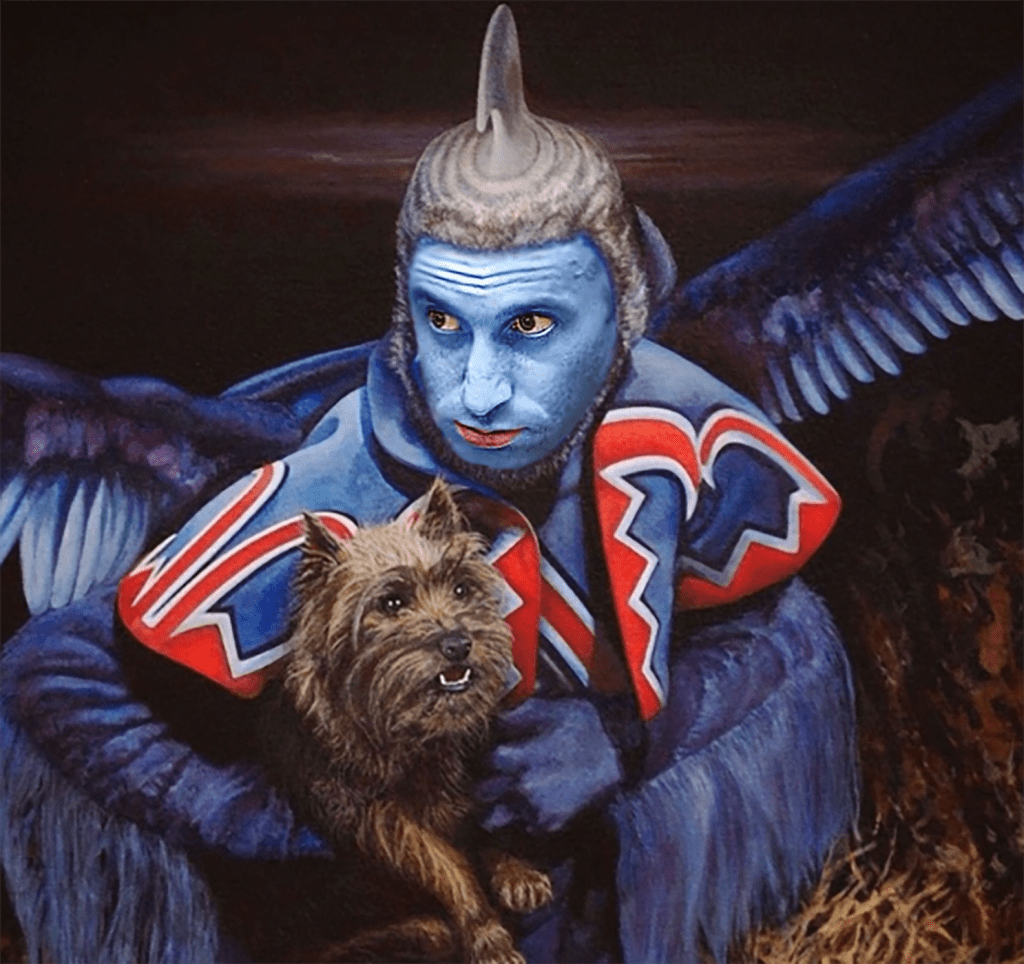


J.R. Murgatroid, The Scarecrow, his voice, a plaintive wail complains, “They said Glinda was Good. She promised answers. But she sent me to a fire. I was meant to burn! And Amelia, she saved me. But to save me, she killed the WWW! I have no brain, but even i can see the algebra of it: my life for the Glinda’s convenience. The supposed good serves itself with my straw-filled body!”
Next, Milo Woodsman, the Tin Man, in a cold, metallic voice added, “Glinda presented a problem, and a solution that benefitted her. Oscar, the Wizard, simply reframes every corruption as a virtue. Amoral, efficient, both of them. One uses observation, the other uses noise. Neither cares for true justice. I seek efficiency, but this is merely a shell game of power. I still have no heart, but i believe i see how useful the idea of one is to those who wield power.”
Not to be forgotten, Delicate Donny Goldencalf, the Cowardly Lion, sobbing theatrically, puffs out his chest. “I want to be King. King of the forest! But every King in Oz, even the ‘Good’ one, must walk through the mud to get there. Glinda used a nurse! A nurse! Oscar used the personal low-blow as a stepping stone! It is all a show, a magnificent, terrifying show. Perhaps my lack of courage is simply the wisdom to see how dirty the crown truly is! But I still want it.”
Finally, Amelia Wolfe, the nurse, practical, exasperated spoke for all, “I am a nurse. I put out a fire. I saved a life. That’s my job. I didn’t intend to kill anyone. I don’t care about ‘Wizardly Prerogatives’ or ‘Persuasion Paradoxes.’ I just wanna go home. All i see is a frightened man on a loud throne, and a woman who uses people as pawns, and a political system built on deceit and noise. This Oz of yours is a sick place, and i can’t treat everyone for collective delusion! Where’s my flying machine?”
The spotlight on our pilgrims fades and the smoking narrator reappears among the surrounding darkness. Snuffing out his cigarette, he launches into an epilogue, “And there you have it… the journey continues; the Scarecrow is no closer to a brain; the Tin Man is no closer to his cybernetic godhood; the Lion is no closer to his crown; and the Nurse? She’s still stuck in the middle of a political disaster, simply because she acted on instinct. The good are not always good. The evil are not always evil. They’re all simply people, or figures, or tin, or straw, pursuing their own ambitions.” And with that, the narrator fades to black, and a panoramic shot of glittering Riviera City fades in.
And the moral of this Audiovision presentation, if you can call it that, is simple: In the end, it doesn’t matter if you are a Munchkin, a Monkey, a Nurse, or a Lion. If you stand in the way of power, or if you serve power too completely, you will be used, you will be discarded, or you will be extinguished. And the Wizard? He sits on his throne, protected by noise, protected by the same Quadlings, Gillikans, Winkies, Munchkins, and naturalized Oompa Loompas he abuses. He’s the master of the turnabout. But is he a symptom of Oz corruption, or the cause?
The panoramic shot of glittering Riviera City fades out and a single, large banner drops, bearing the stark motto: “THE POWER OF THE WIZARD… WILL NOT BE QUESTIONED!”
Or will it…?
Who decides?

 Loopcircus