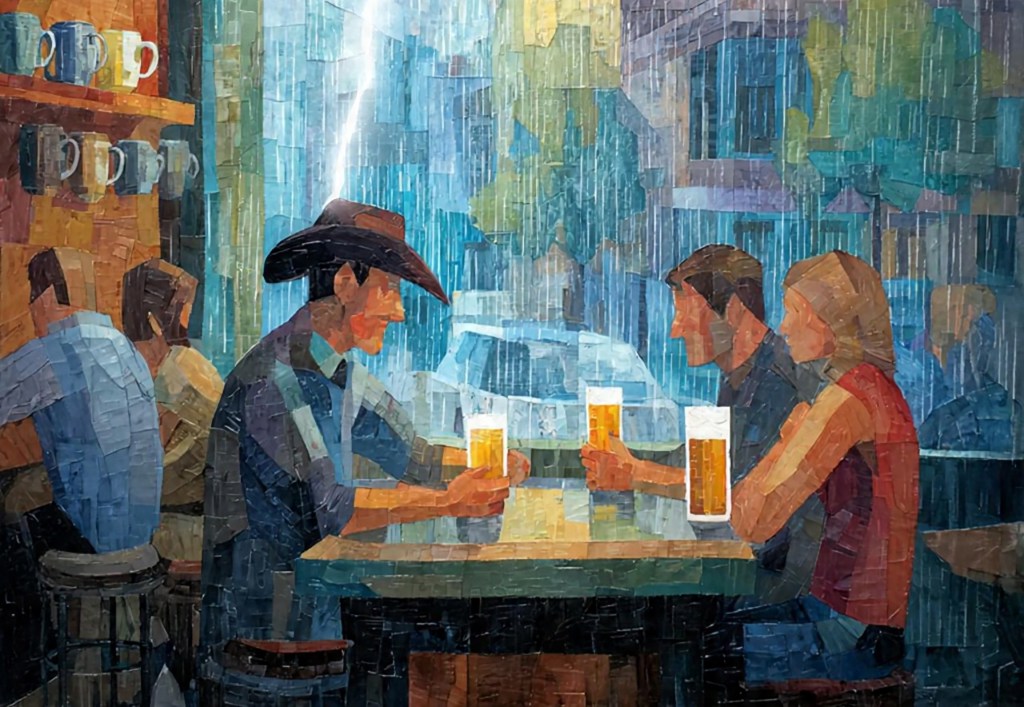
CHAPTER 12: The Chool Bus survives a torrential downpour and Buck is treated to a personal data colonoscopy.
It was late afternoon and storm clouds were gathering, a June rarity in Salt Lake City. So the Forks rode together to a designated brewpub near the capital. After some post-interview observations discussing the unique character of the locals, appetizers and beers were ordered and the Forks endeavored to dig into the personal history of their fuckin’ new guy as Billie would put it, FNG for short. It was going to be a long year and Buck Wellstone had some catchin’ up to do with this tight-knit trio. So Jack kicked the game into play with the first question. “Tell us about yourself, Buck, and give us a sense of your personal influences,” Jack anticipated a painful norm of reciprocity exercise as he expected everyone to be as reticent as himself.
“Sure,” Buck began. He was grinning as if he had endured this kind of personal colonoscopy before. Taking on a subtle shift in affect, perhaps channeling campfire moments among his early adulthood classmates and friends back home, he launched into a lyrical monologue.
“Likely as not, you’ve got me sized up already, ‘account of me hailin’ from South Texas and puttin’ in my time up there in Wyomin’. Fair enough. I don’t much hide the way i was raised. But i’ll tell you straight… i ain’t never crossed trails with a man who looks a lick like that fella on the billboard. You know the one… stiff-jawed, a smoke hangin’ just so, and a sunset that looks like it was painted on by someone who never broke a sweat in his life. The truth of the matter is, a modern cowboy doesn’t just sprout from some fancy marketing scheme. No, sir. We’re a uniquely American gumbo… a rich stirrin’ of traditions that surely don’t require the blessin’ of a Madison Avenue suit to know who we are.”
This piqued the interest of everyone. Professor T remembered his childhood, watching all those black & white westerns on one of the only TV channels that came in clear, Gunsmoke, The Rifleman, Bonanza, and Rawhide. Jack was partial to the Coen Brothers’ take on the 1970s classic True Grit, and Billie’s schema of American cowboys came from movies like The Urban Cowboy, The Midnight Cowboy, The Power of Dog, and Butch Cassidy and the Sundance Kid.
The pints and bites had arrived, and as the Forks split rapt attention between sips, nibbles, and Buck’s verbal tapestry, the minutes flew by between distant peals of thunder. “You see, when it comes to rodeo culture and cowboys in general, there are two flavors. You’ve got the ones who take it all quite sober, lookin’ at a steer like a geometry proof that has to be solved in less than eight seconds. Then you’ve got the others… the devil may care thrill seekers in it for the grins, giggles, and enough cold beer to drown a water buffalo.”
Buck took a long, thirsty pull from his pint of pilsner, dipped a fried mushroom in the ranch dressing provided and resumed. “I find myself reminiscin’ about a particular gentleman… a steer roper by trade… who held the firm conviction that every livin’ soul on God’s green earth, whether man or beast, ought to be tempered as stout as a well-worn saddle. One fine afternoon, he invited a rather refined city fellow out for a ride through the brush. They journeyed until the shadows stretched out as long as a California Sequoia, at which point our prankster looked that dandy square in the eye and said, ‘I’m afraid we’ve lost our way, friend. It appears we’ll be beddin’ down beneath the stars tonight, much like the range riders of old.’ And indeed they did. They made do with naught but sweat-dampened saddle blankets for their pillows and their covers. That poor fellow endured the night, tremblin’ with the chill and feelin’ a mite worse for wear, likely contemplatin’ the series of unfortunate decisions that led him to that patch of dirt. When the sun finally graced the horizon, they crested the very next rise… and lo and behold, there sat that scoundrel’s bunkhouse, not a mile’s distance away. It is, i suppose, a rather stern lesson that the ‘good ol’ days’ were often seasoned with a generous helpin’ of most disagreeable circumstances.”
Just then a bolt from Zeus’ quiver slammed into something not but a few blocks away. The thunder crash rattled the custom mugs hanging from hooks above the bartender’s head. It was like a jump scare moment in a horror movie, but Buck was unfazed. “The cowboy itch hits everyone different. Like me, some apply to the University of Wyoming after catchin’ the fever at Frontier Days in Cheyenne. Now, that’s a tradition that started back in 1897 when the cattle barons wanted to lure in some new blood and get their city noticed. They organized a little get-together, a few thousand folks showed up, and a century later, the cowboy games show no sign of lettin’ up. Today, you’ve got young people and city folk comin’ for the buzz, all united by stubby-bottle banquet beer, coiled ropes, and lonesome hopes.”
“I’ve heard a little about the Cheyenne Rodeo. I’ve always wanted to go, but haven’t made it yet. Tell us about it, Buck.” Professor T wanted to hear it from someone with actual experience.
Buck took a measured breath, offerin’ a polite nod as he gathered his thoughts. “Well now,” he began, “it all commences with a grand parade, much like that very first gatherin’ back in eighteen-hundred and ninety-seven. The thoroughfares are fairly teemin’ with… well, pardon my bluntness, but there’s a fair amount of hoss apples and a great deal of ranch finery polished to a high shine for the occasion. You’ll see the Miss Rodeos from every state in the West, perched high in their saddles, sparklin’ in sequins and Stetsons, callin’ out to the crowds with the most marvelous, wild enthusiasm. But, you see, a rodeo simply isn’t a rodeo without the livestock. Behind those chutes, there lies a labyrinth of what one might call restrained fury. You’ll find bulls that possess the sheer, muscular presence of a behemoth wrapped in rawhide, and broncs that seem to be patiently waitin’ for some unsuspecting tourist to lean just a bit too close… providin’ them the opportunity to make a quick meal of a fine straw hat.”
Another not so distant peal of thunder, then the sky opened up like the Jolly Green Giant dumping a bucket on the roof.
“It’s a partnership of sorts.” Buck was unshakable. “Though a violent one. Half a rider’s score depends on the animal’s performance. These bulls and broncs are athletes… and believe me, they’re just as keyed up for the clash as the riders are. The cowboys themselves? They’re friendly, they’re nervous, and they ought to be scared shitless to be strappin’ themselves to a ton of fury that wants ’em gone by any means necessary.”
“BOOM!” bellowed Mother Nature.
“Should we be checking the bus for leaks?” Professor T was worried.
“Naw.” Billie saw the storm coming. She made sure all of the windows and ceiling vents were closed before retiring to the pub. “I did an idiot check, and the roof fixtures are made with the latest weatherproof sealant. It better not be leaking. Please, Buck, continue.” Billie was riveted by Buck’s back story.
“Anyway…” Buck was sufficiently warmed up. “The gate swings, the announcer’s voice twangs over the PA, and high-energy rock music blares loud enough to rattle your fillings. If the cowboy hangs on for the required eight seconds, they might get a commemorative belt buckle. If not? They get lashed, whiplashed, and finally just throwed.”
“I’ve seen video of modern rodeos, the cowboys wear kevlar vests and face masks to guard against getting gored,” Jack remarked.
Buck took a moment, his expression softenin’ with a touch of gravity… he’d seen too many good men broken by those temperamental beasts to ever treat the matter lightly. “Now, you must understand,” he continued, “these measures were put in place followin’ some truly somber tragedies. More importantly, we must consider the modern bullfighter. And i beg of you, don’t go doin’ that man the disservice of callin’ him a clown. He is, in every sense that matters, a soldier draped in denim and cleats. He performs a most perilous dance between a thunderin’ bull and a fallen rider, actin’ as a courageous decoy. He moves with the nimble grace of a varsity halfback, pivotin’ and spinnin’ away from those brutes… creatures that acknowledge no rules of engagement, possessin’ naught but pure, unadulterated fury. He’ll willingly place himself in harm’s way to shield a man he might’ve only just met over a cup of coffee at the snack bar. They may well paint their faces and employ a few colorful barrels for the sake of the children’s amusement, but mark my words: their true callin’ has precious little to do with provokin’ a laugh.”
“I love to watch the rodeo clowns… they’re like clairvoyants anticipating the animals’ play.” Billie appeared to be a closet cowgirl, something she had yet to reveal about herself as country music was mostly the subject of caustic ridicule in the Grunge-Metal community.
“Anyway, my dad is the most influential person in my life, and he loved the cowboy mythos. I’m more than happy to follow in his bootsteps.” Buck was winding down. “It’s a bizarre world, this modern West. We’ve got city dandys in snakeskin boots browsin’ ropin’ tutorials on YouTube and TikTok. Sorta like that movie Billie mentioned, the one with that disco dancin’ dude, what’s his name?” This rankled Jack as one of his favorite movies is Pulp Fiction, and EVERYBODY knows John Travolta, right?
“You mean Urban Cowboy John Revolta, don’cha?” Professor T was starting to get a little tipsy.
“Nobody’s expectin’ any of this to make any sense,” Buck said. “And when the dust settles and the games are played out, there’s usually nothin’ left to do but get drunk and talk about what might’ve been. See, my dad says the mythical cowboy will be with us for a long, long time. Like the outlaw biker, he’s here for the perpetually alienated to appropriate, defy, or reclaim as we all squint against the fog of this ongoing culture war… what does Professor T call it?”
“The fibrillating heart of our divided nation,” answered the good professor.
Buck, eager to dive into the food, put a lid on his monologue, “For some reason… maybe it’s the dirt, maybe it’s the danger, or maybe it’s just the hat… we just can’t quit the cowboy mythos. And it’s a long way from 1897, but the spirit’s still the same… life is tough, the ground is hard, and ya better hold on tight.”
“Here here,” Professor T hiccupped.
“Thank you for your patience,” said Jack. “I have a greater appreciation for cowboy culture. Maybe we can catch a rodeo somewhere on the tour. There’s one in South Florida in January. That ain’t a bad place to be in the dead of winter.”
As Billie and Jack conferred over the next leg of the tour, Professor T motioned for the check. Mother Nature had finally let up on the rain, and the Forks plus Buck would make their way to the campground for a good night’s rest, providing they don’t find puddles in their sleeping bunks.
NEXT WEEK:
Idaho enroute to Washington State
GO BACK => Preface and Chapter Links
 Loopcircus