This Land: South Carolina

So, we’re rolling into South Carolina, aye? And there ain’t any hot springs. Nada. Zip. Zilch.

THE GOOD: South Carolina’s got plenty of choices for college. Little ones, medium-sized ones… like a box of assorted chocolates, only instead of sweet surprises, you get knowledge. Or something like that. You’ve got your College of Charleston, your Furman University, your Wofford College… even Clemson, though it’s so big it practically needs its own zip code.

And if you’re a bookworm, don’t despair. South Carolina might not be Faulkner country, but it’s got its own literary quirks. The Gibbes Museum in Charleston has enough Southern art and literature to make your head spin. Plus, the whole state’s littered with historic homes and plantations – you know, the kind with long, shadowy porches and a whole lotta history (and maybe a few ghosts) tucked away inside.

Now, if you ask a South Carolinian what they love about their state, they’ll probably start waxing poetic about the scenery. Mountains, beaches, swamps… it’s like Mother Nature threw a dart at a map and said, “Let’s put it all right here.” Of course, they’ll also mention the history. Charleston, in particular, is like stepping into a time machine, with its cobblestone streets and Gullah culture. And the people? Well, they’re friendly, that’s for sure. Southern hospitality ain’t just a saying, folks.

Oh, and did we mention the cost of living? Compared to some places (uh, California), South Carolina’s practically giving it away. So if you’re young and broke but still clinging to that tattered American Dream, this could be your destiny.

THE BAD: The infrastructure… some of those roads are so bumpy, you’ll think you’re riding a buckboard wagon. And the summers? Hoo boy. Imagine a sauna that also happens to be outside. That’s the dog days of July and August in South Carolina.

THE UGLY: The political climate? Let’s just say it’s redder than a sunburn. In 1932, most of South Carolina voters, nearly all white in a state where nearly half the residents were Black but not able to cast ballots, chose Liberal FDR for president at the start of the Great Depression. Ever since, the conservative backlash has been long, steady, and at times infused by racism. Among the landmark moments include Strom Thurmond’s 24-hour filibuster against the Civil Rights act in 1954, then his decision to switch to the Republican Party continuing the fight to block civil rights legislation in Congress.

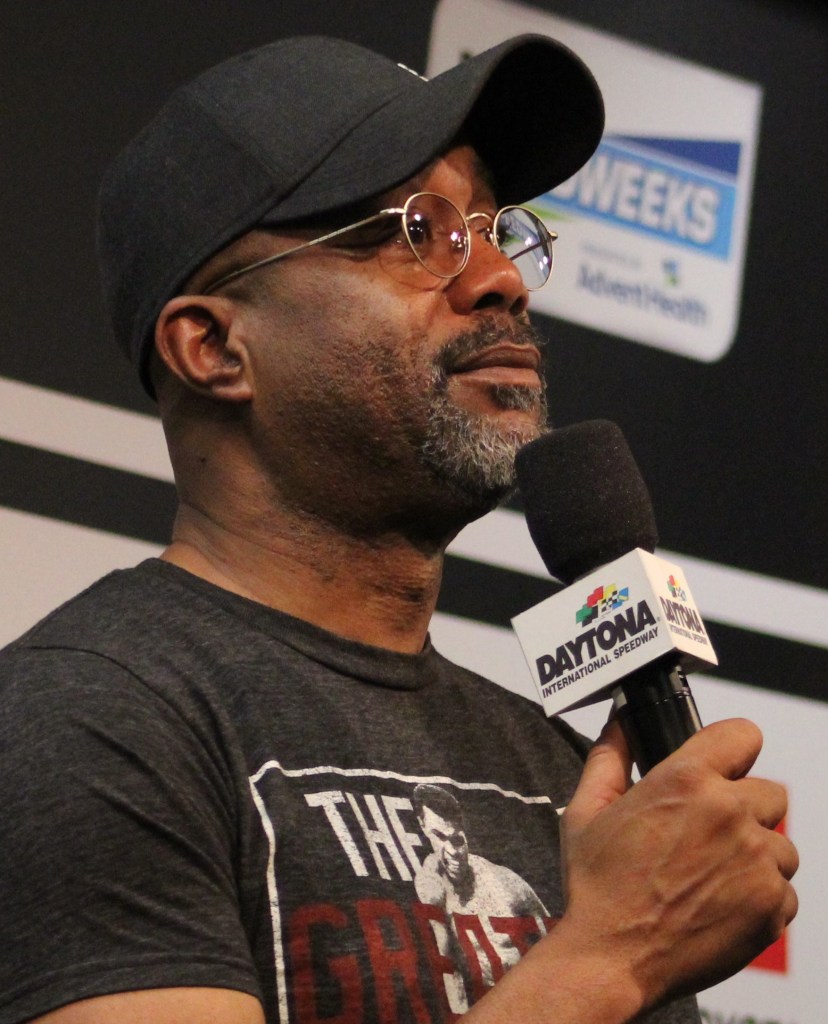
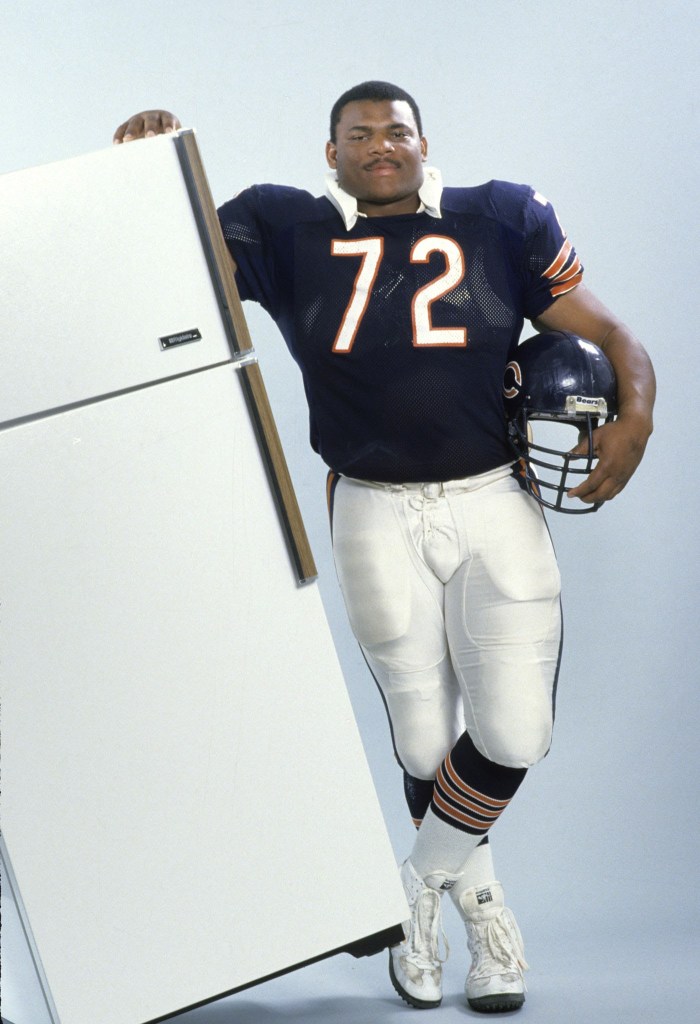
So, who’s who from South Carolina? Well, there’s Darius Rucker, the country crooner who used to front Hootie and the Blowfish. There’s William Refrigerator Perry, lineman for the Chicago Bears in the 1980s. There’s James Brown, the hardest working man in show business. And the ever-graceful Vanna White from the Wheel of Fortune game show. Oh, and let’s not forget Strom Thurmond. Yeah, South Carolina’s got a complicated past.
Now, Ronnie hasn’t resided East of the Mississippi, so he can’t say for sure what the people in the two Carolinas think of one another. But we’ve heard whispers. Apparently, North Carolinians think South Carolinians are a bit slow. Laid-back, even. And South Carolinians? Well, they think North Carolinians are a bit uptight. All work and no play, you know the type. But hey, at the end of the day, they’re both Southern states. They love their college football, their barbecue, and their beaches. So maybe they’re not so different after all.

Anyway, South Carolina’s an interesting place. It’s beautiful and frustrating, welcoming and backward, all at the same time. The job market’s getting better, but it’s still tough to make a decent living in some parts. And while the state’s slowly becoming more diverse, it’s still got a long way to go.

So, is South Carolina for you? That’s a question only you can answer. But if you do decide to take the plunge, just remember: pack your sense of humor, your mosquito repellent, and your open mind. You’re gonna need ’em.

Onward through the fog… RH

As we were rolling…
‘Long a Carolina shoreline…
We saw the truth…
Across the skyline…
It brought us back to…
First principles…
This land is here…
For you and me.

Lucky Ones

Just a small town kitty with a map of the city and not much else to claim… picked up a one way ticket outta here… to find fortune and fame

Well… i don’t know much about livin’ high… never had too much at all… so i really admire that girl who left here… to find fortune and fame.

With a tear in her beer… she tried to explain… how she tried and tried but did not live up to her name… and the deacons… the merchants… the coffee shop congress agreed… that she couldn’t have picked a better time to break free.

One flew over…
To see what she could see…
One flew over… only…
To discover the things you gotta trade… for the dream.

Aren’t we the lucky ones?

Well… there’s a feeling around here… echos of sadness… i can’t seem to trace. One more time at the wishin’ well… a lonely… lovely place.

Well… it seems the American Dream… only boats against the tide… driftin’ shiftin’… always outta reach… like pin-lights cross the great divide.

A public socialite she had come to be… not a soul saw her off… save for me… and the fakers the takers… the singles bar congress agreed… that she couldn’t have picked a better time to leave.

One flew over…
To see what she could see…
One flew over… only…
To discover the things you gotta trade…
The things you gotta trade… for the dream.

Aren’t we the lucky ones?

Hot Springs or Busk: Chapter XI (plotting a course)

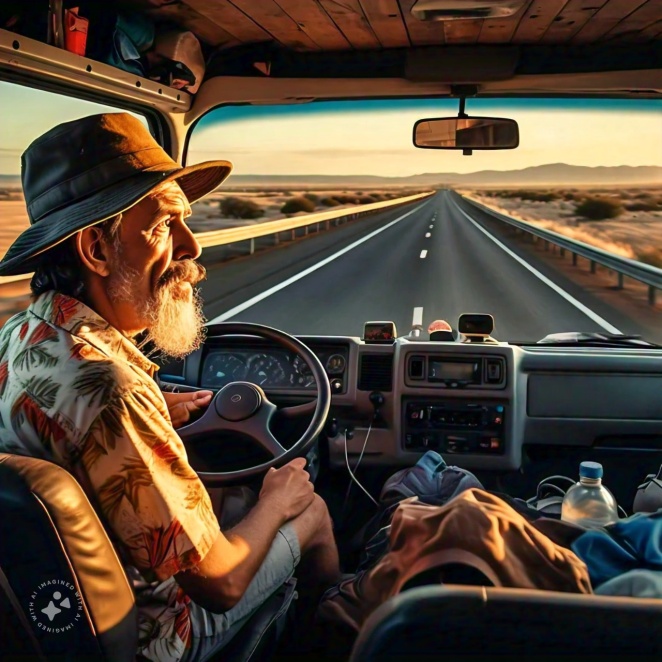
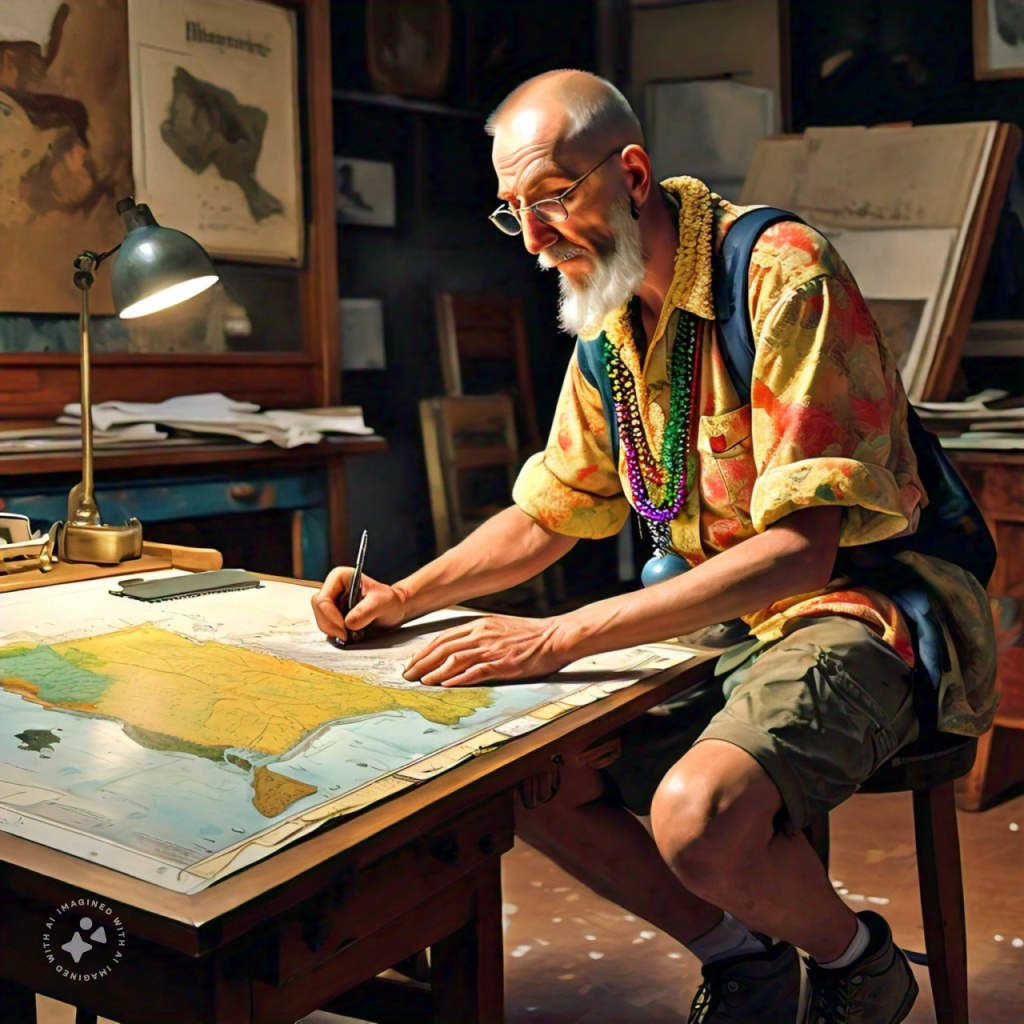
Picture this, America: some aging fool and his four-wheeled testament to stubbornness, baptized “Rocinante” for that same delusional optimism. Me? I’m trading academe for the wide-open spaces, tilting at the broadcast towers of mainstream media following a loose spine of favorable climates and college towns across these 48 states.

You see, I’ve got this itch. This notion that the true pulse of America isn’t in corporate board rooms or the marbled halls of power, but in the sticky floors of dive bars, the sun-baked town squares, and the yawning lecture halls of universities. So, Rocinante and i, we’re on a quest.

First things first, a man can’t get to the heart of the American Dream on an empty stomach. In each town, the routine is honed with a survivalist’s focus: hygiene out of the way (gyms, truck stops, even the occasional river bath for that true hobo chic), laundry refreshed, and Rocinante’s belly restocked with fuel and provisions. Local libraries become my sanctum – free internet, musty books, a whiff of intellectualism to ward off the creeping road madness.

Then, the hunt begins. I stalk state facts like a cornered possum, armed with Wikipedia and an unhealthy obsession with the bizarre and overlooked. Then it’s into the fray! I corner unsuspecting locals, less like an intrepid reporter and more like a stray dog sniffing out dinner.

“What’s your state motto?” I’ll ask, eyes gleaming with the zeal of a half-crazed Jeremiah. Then the real fun – listening as they fumble, praise, or outright despise those hallowed words. This, loopers, is raw, unfiltered Americana that no cable pundit can manufacture. It gets distilled into my loopy travel-blog dispatches over whatever questionable Wi-Fi i can scrounge.

College campuses – they’re the petri dishes of society, bubbling with idealism, hormones, and all that youthful angst. If there’s unrest brewing, Ronnie Hays has a front-row seat. Not to incite riots, but to chronicle the messy, beautiful chaos of young minds at war with a world that doesn’t seem to give two spits.

Now, this land, it sings to me. Woody Guthrie’s ghost haunts my guitar case. In each state, i’ll pen my own crooked verse of “This Land is Your Land,” a wind-whipped, low-fi ode to the cracked highways and resilient souls i find. Welcome signs become my stage, YouTube my tin-can amplifier.

Planning ain’t my strong suit. Half the joy is in the detours. But hot springs? Oh, sweet geothermal bliss. i’ll soak these old bones till they’re soft as a boiled noodle, conjuring up the ghosts of grizzled prospectors and bathing beauties while i fend off mosquitoes.

To fund this glorious mess, a little busking. My luting skills ain’t Carnegie Hall material, but it’ll buy a burger, or at least a sympathetic chuckle from passersby.

And so, it begins. A year under the vast American sky, a tin can Don Quixote fueled by French roast and stubborn hope. Expect tales of barroom philosophers, off-grid eccentrics, and everyday folks grappling with the beautiful, broken heart of this country. Expect a whole lotta nonsense, a dash of truth, and maybe, just maybe, a sliver of understanding about this glorious, maddening, never-ending experiment called America.

Onward through the fog… R.H.

Hot Springs or Busk: Chapter VI (class bamboozle)

America, that grand experiment in democracy and greasy cheeseburgers, has split in two. It’s a nation of Penthouse and Outhouse, caviar dreams and dumpster diving. And in San Francisco, the poster child of this cracked reality, the divide slices cleaner than a Zuckerberg algorithm.

On one side of the looking glass, you have the Tech Titans. Think smooth-faced whiz kids who probably still get carded for rated-R movies, but their bank accounts have more zeroes than the national debt. They cruise around in their self-driving Teslas, sleek as chrome beetles, sipping twenty-dollar green smoothies. Their fortress-like penthouses look out on the city like bored gods on an anthill. At night, they gather at fundraisers you couldn’t buy your way into with a suitcase full of pirate treasure, nibbling on edible gold and discussing the colonization of Mars. It’s enough to make a regular Jane want to scream into her tear-stained pillow.

Then, there’s the other side… the sidewalk crew. These are the folks who exist in the blind spots of the digital aristocracy. Tents sprout like poisonous mushrooms along cracked concrete, faces etched with a lifetime of hard luck, and eyes that mirror the dull sheen of discarded iPhones. They push their worldly belongings in shopping carts, a symphony of rattling wheels and despair that no noise-canceling headphones can drown out. The smell of unwashed bodies and stale urine hangs heavy in the air, a constant reminder that while some worry about stock options, others worry about their next meal.

The great irony, one that would have Kurt Vonnegut cackling into his cornflakes, is that these two Americas need each other. The tech overlords, for all their billions, would be lost without the army of delivery drivers, baristas, and dog walkers that keep their designer lives running like clockwork. And let’s not forget those poor souls who clean up the aftermath of their all-night coding binges fueled by energy drinks that could power a small nation.

Meanwhile, the street folks are an endless source of moral hand-wringing for the penthouse set. They fuel charity galas, anguished blog posts, and the occasional guilt-ridden donation tossed to a panhandler like a bone to a stray dog. It’s a sick kind of symbiosis, the way their high-tech kicks need the muddy puddle to prove just how awesome they are.

H. L. Mencken, the old cynic, would have a field day with this mess. We can practically hear him snorting into his whiskey highball: “Democracy is the theory that the common people know what they want, and deserve to get it good and hard.” Ouch.

The thing is, nobody seems to be doing anything about this chasm that grows wider with each passing Uber Eats order. Politicians, as usual, are flapping their mouths like beached fish, some spinning promises about fixing a broken system that’s been cracked since before iPhones were a twinkle in Steve Jobs’ eye, others still blaming the poor for not pulling on their bootstraps hard enough. Both sides, with a few rare exceptions, not even trying to hide the fact that they are bought and paid for in a system of abject corruption. They’re too busy eyeing their campaign donors in those sterile fundraisers to actually do anything that might rock the boat.

So it goes. While the tech wizards dream of space colonies and the sidewalk crew prays for a dry patch of pavement, the rest of us stand somewhere in the middle, bewildered and nauseous from the whiplash. The great American experiment, once a beacon of hope and hotdogs, now resembles something more like a Salvador Dali painting… melting, distorted, and just plain bizarre.