Hot Springs or Busk: Chapter V (genderpocalypse)

In the chaos of twisted chromosomes and warring hormones, we stumble upon the battleground known as “gender identity.” Picture it, loopers: a cosmic joke played on the fleshy stage of human existence. On one side, we have the cold, hard warriors of science, armed with their microscopes, brain scans, and impenetrable jargon, dissecting the very essence of what it means to be a dude or a chick. Like a swarm of blue ants, they peck away at the X and Y chromosomes… they focus their compound lenses on squishy gray folds of the brain hoping to uncover the secret lair of gender.

On the other side, we’ve got a dubious combination of politics and religion. And like red ants quoting holy scripture confined in a glass jar with the lab-coat wearing blues, all are content to share the space peacefully until someone comes along and shakes the jar. Ideologies and agendas are imposed upon the mix, where gender is leveraged as a weapon, a war cry, a bargaining chip designed to divide in order to conquer. Here, the forces of division speak in tongues, twisting words like “identity” and “expression” into righteous mandibles and impenetrable exoskeleton. They invent fake threats, hurl buzzwords like sugar crystals, and paint the very notion of gender itself as some kind of existential threat against all ant-kind. It’s an artfully designed battle, loopers, where common sense goes to die and the casualties are sanity and nuance… but enough of this ant-jar metaphor.

Caught in the political shitstorm, behold, the ordinary human! A curious creature, armed with little more than a body that feels and a mind that questions. “Who am i?” they wonder, peering into the distorted screen of warring society. “Am i what the textbooks say i am, what my birth certificate proclaims? Or am i something more, something deeper, an echo of feeling that defies the rigid rules of biology?” The scientists, bless their methodical hearts, try to offer answers, mapping out hormonal landscapes and brain circuitry. But what do they really know about being trapped in a body that feels like a prison, or feeling a defiant joy under a label that the world wants to erase?

Meanwhile, politicians bellow and posture. Christian Nationalists, with their faces twisted in apocalyptic fury, see transgender folks as harbingers of societal collapse, demonic agents sent to shatter the sacred order of man, woman, and holy matrimony. They clutch their dog-eared Bibles like shields, shouting verses about abominations as if the wrath of God himself will smite down those who dare to blur the lines. Oh, the irony, loopers, for aren’t those holy books dripping with gender-bending stories? Androgynist angels, prophets who blur the lines of man and woman… all stuff of genderqueer fever dreams!

And let’s not forget the paragons of liberal tolerance, sometimes just as ridged and uncompromising. Armed with academic tomes and social justice battle cries, they paint gender as a fluid, ever-shifting spectrum, where the very act of categorization is an act of violence. For them, biology is a mere suggestion, pronouns a tool of liberation, and self-declaration of the highest law. To question their orthodoxy is to be cast as bigoted troglodytes, clinging to a world that no longer exists, a relic of a less enlightened age… nuance be damned.

So, here we are, loopers, trapped in this absurdist play. The lab-coat wearing blue ants fiddle with their instruments, hoping to find a grand unifying theory of gender, while the red culture-warriors trade barbs and twist reality like cheap balloon animals. Yet, in the end, what does any of this say about the boy who looks in the mirror and sees a girl staring back, or the woman who feels like a stranger in her own skin? It’s the eternal human struggle played out on a new stage… a struggle to simply be, to exist without judgment, to find a sliver of peace in this glorious, messy, and often nonsensical thing Bill Hicks reminds us is just a ride.”

And where does our fictional alter-ego fit in this absurdist play? Well, Ronnie Hays says he’s a woman trapped in a man’s body, but that woman happens to be a lesbian. So… the deviance is nearly imperceptible because if he’s dating… he’s dating a woman, and since his skin, flesh, and blood is male from the get go… NO ONE notices something amiss.

Cheers… Loopcircus

Hot Springs or Busk: Chapter IV (arc of the spiral)

In an attempt to illuminate where Loopcircus is coming from, metaphysically speaking, we’ll draw a brief allegory of humankind’s struggle to understand its place in the universe as an ever oscillating battle between those who insist there is a particular source from which all creation springs and those who insist we can observe the universe as the result of billions of years of adaptive (and otherwise) incremental changes. Loopcircus may be tempted to side with one or the other of these conflicting views, but the bare-metal truth is we don’t know… nor do we believe ANYONE truly knows. So… without further adieu, the spiral of puny human metaphysical understanding from Gilgamesh to Sagan.

In the beginning, there was dust, then clay, then Gilgamesh, a king who wrestled gods, chased immortality, and discovered, like a Vegas lounge lizard hungover in a bathtub full of pennies, that life’s a fleeting joke. Fast forward a few millennia, and the frame focuses on the desert of Palestine, where a carpenter’s son strolls in, flips the metaphysical tables, and promises an afterlife juicier than a Lebanese fig. This, my friends, is the Big Bang of Western metaphysics.

Centuries later, Europe enters its Renaissance, a period where deities dance the can-can with da Vinci’s anatomy sketches and Galileo gets poked in the eye by the Vatican for suggesting Earth isn’t the cosmic navel. Science, now a pimply teenager with a telescope, starts flexing its muscles, whispering sweet nothings of reason and logic to the masses. And religion, the aging aristocrat clutching its pearls, declares war.

Enter Darwin, a fellow with a penchant for Galapagos finches, drops an apparent truth bomb making the Colosseum look like a petting zoo. Suddenly, humanity isn’t God’s special snowflake, but a hairy cousin to the orangutan, scrambling up the evolutionary ladder in a desperate bid to avoid becoming monkey chow. Cue the Wagnerian strains of existential angst, thicker than London fog, and the rise of Nietzsche, and his magnificent mustache.

Across the pond, the soon to be U.S.A., a rambunctious toddler all hopped up on Manifest Destiny, is busy carving its own metaphysical niche. The Wild West, a whiskey-soaked fever dream, birthed bootstraps pragmatism, a philosophy as rugged as a cowboy’s chaps, where truth is measured by bullets, dollars, and cents, not divine pronouncements. Meanwhile, in the East Coast salons, Emerson and Thoreau, Transcendentalist proto-hippies on a nature binge, preach a gospel of self-reliance and communion with the cosmos, a far cry from the fire-and-brimstone sermons echoing from the puritan pulpits.

The 20th century, a rollercoaster ride through world wars and atomic bombs, left humanity bruised and questioning. Freud, a psychoanalyst with a penchant for cigars and Electra complexes, peered into the murky depths of the human psyche, revealing a primal soup of desires and neuroses far removed from the squeaky-clean narratives of organized religion. Existentialism, a philosophy as bleak as a Greek Tragedy, became the soundtrack of the disillusioned, while pop culture, a neon-lit funhouse, offered fleeting solace in the form of Elvis’ hips and Marilyn’s pout.

And now, in the 21st century, the stage is split. On one side, the Intelligent Design revival, a troupe of fire-and-brimstone preachers, resurrects the old gods, their voices booming with the righteous fury of a televangelist hawking snake oil. On the other, Carl Sagan’s disciples, hold aloft the flickering torch of reason, their voices laced with the wry humor of a scientist explaining the Big Bang to a five-year-old.

Then there’s we, the ever-curious, popcorn in hand, watching this embarrassing spectacle unfold. Will we turn into pillars of salt? Will fire and brimstone engulf the stage, will the Saganite laughter pierce the darkness? Or will Camus, W.B. Yeats, and George Carlin’s detached amusement save us from the disease of “passionate intensity?” The curtain has yet to fall, and the play, as always, goes on. One thing seems destined to persist: The spiral… ever oscillating between extreme attractions and aversions follows a seemingly eternal arc… each epoch like Groundhog Day… round and round the galaxy we spin… forever… and ever… and ever.

Hot Springs or Busk: Chapter III (the digital nomad)

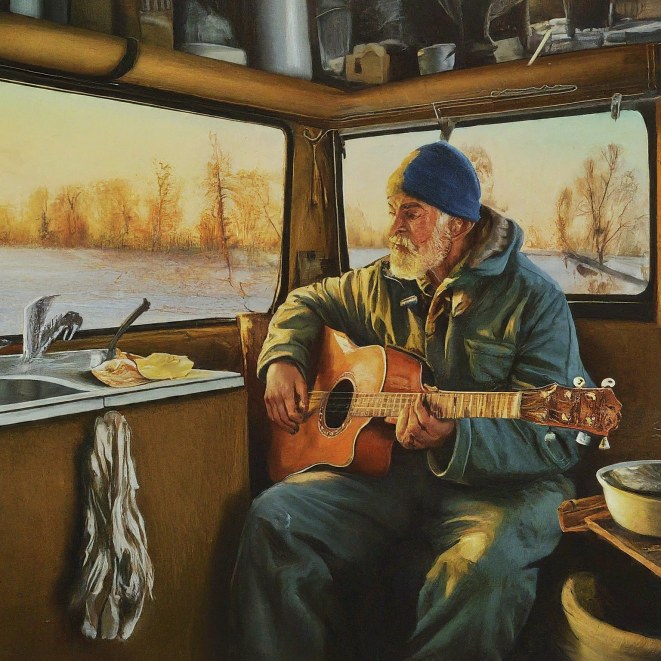
Ronnie Hays, a name that once sent shivers of social dread down the spines of live-music booking agents, now resides in a tiny-home conversion van resembling the inside of a forgotten gym sock. The air, thick with despair and the lingering aroma of last week’s coconut curry, clings to him like a shroud. His muse, that fickle harlot, abandoned him years ago, leaving a mountain of unfinished lyric sheets and a bank account like the Dead Sea… barren and perpetually below sea level.

Ronnie Hays, his once thick shock of 80s glam-metal hair now a half-bald testament to the ravages of entropy, stares out the grime-encrusted window. The Kanorado prairie, stretches before him like a dirty snow-covered purgatory, its barron fields shrouded in drifting dust and tumbleweeds like floating bramble balloons. The wind, kicking up dust-devils, rustles the plastic cutlery collection he’d lovingly curated from various Chinese takeout establishments… his most valuable non-musical possession, if you discount the half-empty cartridge of Delta9 vape-juice tucked precariously behind the spice rack.

His semi-smart-phone, a relic from a bygone era when booking agents actually called independent singer/songwriters, sat silent in his pocket. It hadn’t rung in months, its silence as deafening as a librarian’s shushing. He pulls it out and checks email and social media, a masochistic ritual, then dials his agent’s number. The recorded message, a cheerful chirp followed by an eternity of elevator music, mocks him. He hangs up, the dial tone a hammer blow to his already fragile ego.

Resignation, a bitter pill he chokes down with each passing day, gnaws at him. The live-music world, once a playground of subversive punk and rebellious noize, had transformed into a funhouse of celebrity beefs and vapid cults of personality. His brand of bleak humor and melancholy, once filled with prescient social commentary, now feels like a dusty gramophone record playing to an audience obsessed with the latest TikTok dance trends.

He slumps onto his bed, the mattress platform groaning in protest. The ceiling, adorned with what could only be described as “abstract water damage art,” seems to mock him as well. Was this it? Was Ronnie Hays, the joker who dared to stare into the abyss and write about it, destined to molder in obscurity, not even a footnote in the margins of music history?

A sardonic chuckle escaped his lips. The absurdity of it all, the cosmic joke at his expense, struck him with sudden clarity. He wasn’t Atlas, shouldering the burden of humanity’s enlightenment. He was Sisyphus, forever condemned to roll the boulder of his obscure discography up the mountain of indifference, only to watch it roll back down each morning.

And then, a strange sense of peace washed over him. The pressure to be relevant, to change the world, evaporated. He was the mongrel of rueful countenance, an earthbound cosmic troubadour, a digital nomad, a seeker of truth in a world obsessed with glittering celebrity. And if the world didn’t want his brand of truth, well, screw ’em. He’d keep writing, not for accolades or validation, but for the sheer ecstatic pleasure of it. He’d be a one-man band, playing his discordant symphony in the dark alleyway of pop culture, content in the knowledge that at least the fireflies appreciated his solo performances.

With a newfound lightness, he fires up the workstation. The vape pen winks encouragingly from its hiding place. Tonight, he’ll not write a masterpiece. He’ll write a farce, an absurdist caricature of the world that continues to ignore him. He’ll laugh in the face of oblivion, sardonic humor his favorite weapon, his obscurity a badge of honor. Ronnie Hays, a digital nomad, is back, and the punchline is on all of us.

Cheers… Loopcircus

PS: This is all we have to say about the socio-economic conditions of Rohlfie’s fictional alter-ego. Stay tuned for the hilarious account of his political/religious schtick… 😜

Hot Springs or Busk: Chapter II (mongrel of the rueful countenance)

And so… it’s probably good to get some background out of the way. And whether this public-facing journal features opinion, commentary, straight bald facts, mongrel music, or utterly inexplicable gonzo fiction, it’s important readers/listeners have access to the creator’s ethnic, cultural, socio-economic background, political leanings, as well as religious and/or gender identification. These things should be clear so that, rather than walking on rhetorical eggshells as is the custom these days, we can let our freak-flags fly… let these bare-metal stories/songs live and breathe as we see them. Unbounded by the illusion of disinterested objectivity, let’s pursue what Werner Herzog calls… “Ecstatic Truths.”

And since we’re not in cahoots with a genealogist, nor invested in 23andMe, this particular ancestry reaches back only so far as the late 19th century. It’s a shallow oral history scantly passed down by depression-era grand and great-grandparents. That said, it is an amusing clash of melting pot misfits: Jerrys (Deutsch), Harps (Gaelic), and Brits (English) all mashed together in Uncle Sam’s ethnic stew. Picture this, America: pre-WWI, a land teeming with more immigrant groups than a clown car at a rodeo. Among them, three distinct flavors: Stoic Jerrys, Guinness-swilling Harps, and stiff-upper-lip Brits. Now, imagine them crammed into the stew, a bubbling cauldron promising assimilation but spewing out this mongrel of rueful countenance… the alter-ego, Ronnie Hays.

Anyway, in the pre-war surge, a couple German immigrants (bless their lederhosey hearts) arrived in Pittsburg Kansas having never met in their native city, Bremen Germany. With the efficiency of healthy Volkswagen Beetles, this intrepid couple found a way to thrive in the desolate Kansas prairie. They labored, they brewed, they ooom pa’d with metronome precision. Their industriousness and tireless work-ethic hummed with the ineffable rhythm of Mother Nature’s shifting seasons. A stark contrast with the life and times of one of their sons (we’ll call him “Cool” Carl). Cool Carl moved West, to the gold mines of front-range Colorado, and once these wild-west gold-rush oats were sewn he settled in, built a brick house in the North Denver suburbs and raised a no-nonsense industrial beat-cop turned public works supervisor (call him Grumpalumpagus). This is where the Jerry genes crashed into the U.K. genes. Mr. Grumpalumpagus met and married a U.K. girl from Russell Kansas (we’ll call her Sassy SalGal), and the rest is female emancipation, generation gap, moonshots, hippies, rednecks, Indian uprisings, Viet Nam, race riots, billy clubs, police crackdowns, irreconcilable-differences, and divorce… history.

Add to the 1960s baseball, hot dogs, apple pie, and Chevrolet culture-crisis, a fundamental communication gap between Grumpalumpagus (a Jerry husband) and Sassy SalGal (a U.K. wife) distracted by waves of female emancipation facilitated by the various social safety nets, contraception, and pop-intellectual peer-pressure and you get a three-ring circus of misinterpretations. The Jerry cop’s guttural proclamations insisting women be house servants sent shivers down Sassy SalGal’s back. She might have mistook his alpha pronouncements for some sort of desperate war-of-the-sexes battle cry. The Brit influence in her uttering lyrical oaths under mumbling breath. The playful, but scrappy Harp in her issuing caustic digs like leprechauns on a whiskey rampage. Of course her U.K. sense of sarcastic wit met with bewildered frowns from the Jerry cop, and also alarmed her British father whose clipped pronouncements, delivered as if they were coming from the Queen herself, failed to persuade SalGal back into her pre-emancipation place.

Now… what about our intrepid storyteller and his all-singing-dancing crap-of-the-world alter-ego… this “Yuppytown Refugee?” Well… amid the slapstick of the 1960s and 1970s, something remarkable happened. The Jerry work ethic rubbed off on the Harp’s tendency toward mournful poetry, inspiring our hero to trade brawling for bucking deadlines. The Harp’s infectious penchant for music and storytelling livened up the all-work-no-play grindstone, turning out a somewhat disciplined rueful troubadour with British influence, ever pragmatic, looking for economic potential in this mongrel stew.

Of course, it’s not all work-hard-play-hard and beer. Inner-tensions flare, prejudices fester, and the occasional existential brawl serves as a reminder of the differences that still bubble beneath the surface. But slowly, surely, a new identity emerges, a uniquely American blend of Bratwurst, Guinness, and Monty Python Flying Loopcircus.

Of course…. ch ch ch changes… modern inclusive culture has temporarily ushered him to the sidelines in order to make room for the rainbow character of this remarkable nation. The thing is, none of the normal trappings of acquisitive individualism matters to our mongrel of rueful countenance. The temporary disenfranchisement of white male energy doesn’t bother him at all. And if he can enjoy a few more healthy years for writing, playing, and singing his stories, even if no one is listening, he’s in his element… in need of nothing more.

So, the next time you raise a glass to the American Dream, remember the loopy cultural car crashes somehow managing to forge new soul from fragments of European heritage. It’s not always pretty, it’s not always peaceful, but it has been, and hopefully is still… entertaining.

To list MEMEtic influences would be too long for this posting, but here are a few examples: Kurt Vonnegut‘s irrepressible humor in the face of tragedy, Hunter S. Thompson‘s incisive musical prose, Tom Wolfe‘s wiz-popping use of vivid metaphor, or the entire tower of song mentioned by Leonard Cohen. It’s all part of this grand, messy, beautiful American experiment.

Cheers… Rohlfie

PS: That’s some gene/meme-pool stuff… didn’t get around to socio-economic class, politics, religion, or gender identity. Stay tuned… we’ll get to those things in future postings.


Hot Springs or Busk: Chapter I (the purge)

Happy Funday, loopers! And buckle up, because there is much to do and only months from embarking on a journey of radical proportions… not just to small and medium size college towns across the contiguous 48 (United?) States of America, but into the hitherto uncharted territory of extreme minimalism. You see, before your host can Kerouac across state lines with his trusty guitar and tricked-out sprinter van, he’s gotta Marie Kondo the hell out of his already semi-tidy lifestyle.

Now… purging “stuff” without resorting to a Tyler Durdenesque eruption feels like wrestling a hydra with a shopping cart full of expired coupons. At every corner, another forgotten set of martini glasses, shot glasses, cocktail shakers, beer brewing kits, fondue forks shining with the accusatory glint of a thousand bad decisions… can you relate? Remember that popcorn maker you bought on a whim after a particularly potent batch of brownies? Or the ceramic Elvis bust your aunt Mildred bequeathed you, its rhinestone sunglasses perpetually mocking your life choices? They all gotta go, loopers, jettisoned into the great beyond of thrift shop purgatory.

It’s a Sisyphean task, let me tell you. You purge until your arms feel like overcooked linguine, only to discover a forgotten stack of Wired Magazines leering at you from a box in the guest-room closet, their splashy geek-chic advertisements reflecting the hollowness of consumerism. But with each item exorcised, a strange lightness washes over you. It’s like you’re chiseling through layers of a self-made sarcophagus, emerging, blinking, into the sunlight of… how did William Wallace put it…?

!!FREEEEEDOMM!!

But let’s not sugarcoat this thing. Saying goodbye to stuff feels like attending your own estate sale, inviting strangers to paw through the detritus of your life with the dispassionate curiosity of vultures at a buffet. You see your cherished pulp-n-ink books, once bastions of knowledge, amusement, and inspiration, now reduced to dog-eared doorstops. Your carefully curated vinyl or CD collection? Frisbees… or kindling for a transhumanist bonfire. It’s enough to make you nod along agreeably as Barbara Ehrenreich describes a bait and switch formerly known as the American Dream, built as it is on an ever-expanding foundation of stuff.

But amidst the chaos, there’s a perverse joy. A giddy dance with absurdity as you realize you haven’t worn those bitchin’ parachute pants since the Clinton administration, and that t-shaped sub-woofer cajone, got more use as a foot-stool than a musical instrument.

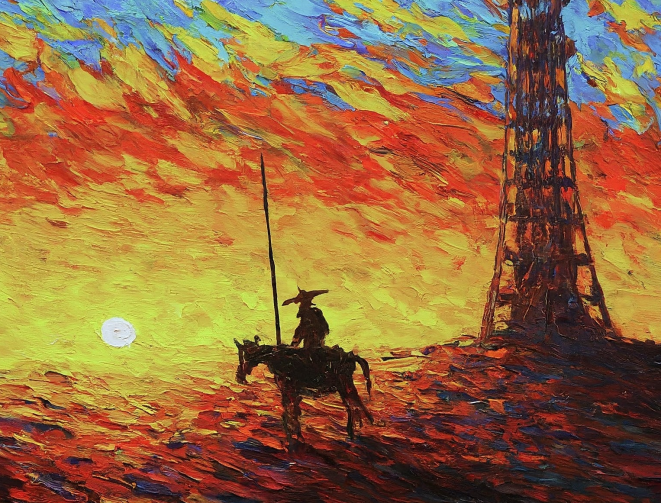
So, as i stand amidst the ruins of my former semi-tidy life, surrounded by mountains of “maybe someday” and “what was I thinking?”, i feel a strange sense of liberation. The micro-bus, once a gleaming symbol of woodstockian wanderlust, now beckons as a deep-space “stealth” ship (a name… hmmm… let’s see… how about “Rocinante?”).

Anyhoo… no more will i be tethered to the tyranny of things. The open road awaits, and i, with Rocinante, and only the essentials (and maybe a slightly dusty foot-stool), am ready to answer its call.

This, loopers, is not just a trip to the thrift shop. It’s a baptism by Marie Kondo, a communion with the open road, a middle finger raised to the gods of consumerism. It’s the year we trade stuff for possibility, and let me tell you, the view from here is anything but beige. Stay tuned, because Rocinante has yet to commence the metamorphosis… the adventure is just beginning!


And so… it begins!

Greetings, Loopers…
And great day in the morning!
Finally… a break from that weeks-long taste of Arctic-brisk.

Argh… over it, i am.

Now, as i was shedding the “bearskin-thick” protective layers, it hit me between the eyes. My 65th birthday and exit from the professional treadmill is mere months away. I promised myself in the doldrums of the post-y2k “dot-bomb” that i would, upon retirement, either A.), buy a wind-powered craft and sail the seven seas or B.) obtain a “Prairie Schooner” and roam the earth like Kwai Chang Caine. Well… the time has arrived, and a few hard truths have forced a semi-sudden pivot with the vehicles i’ll use to fulfill this visualization. For one, this middle of everywhere, landlubbin’ flatlander is a horrible candidate for single-handed sailing, and two, the pop-up tent/awning solution i, only last year, acquired for prairie schooning will work only in perfectly temperate zones. So… people i trust were advising i go the “stealth urban camper” route of acquiring a converted cargo van and turning it into a rolling tiny home. So, i started researching turn-key options and came up for air gasping at six-figure price tags… GAHHHH!

Solution? Acquire an empty van as blank canvas (see above), design, and construct the interior myself (project to begin post-haste).

Once that is accomplished… strap in, loopers, because this ain’t your drunk uncle’s road trip. We are professionals… we have “objectives.” This is a 52-week, 48-state odyssey through the heart of American academia, fueled by equal parts French Roast, guitars, and pure, unadulterated curiosity. We’re hitting Hays America’s sister cities… public college towns, mind you, the kind where dorms smell like stale pizza and regret, and the professors are either jaded veterans or wide-eyed grad students with tenure dreams as fragile as a bong hit in a mosh pit.

But hold on, this ain’t just about singing for my supper in college-towns across the nation. It’s also a quest for the literary Grail, a boozy, bookish bacchanal that’ll have us chasing Hemingway’s ghost in Key West, Kerouac’s shadow in Desolation Peak, and Faulkner’s phantom in Oxford, Mississippi. We’ll be spelunking through dusty library stacks, communing with ghosts, and trading wild stories like currency in smoky campus dives.

And when the sun sets on another day on the road, we’ll seek solace in our nation’s natural cathedrals: Yosemite’s granite giants, Yellowstone’s geyser symphony, the Grand Canyon’s mile-deep abyss. We’ll soak our grumpy bones in hidden hot springs, letting the geothermal magic mend our aching glutes and rekindle our wanderlust.

But be warned, this isn’t for the faint of heart. This is a road paved with potholes and detours, populated by characters as colorful as a Thompson-esque fever dream. We’ll encounter campus radicals and redneck renegades, peyote-toting professors and chain-smoking librarians, all with their own stories to tell, their own demons to chase.

So, are you ready, loopers? Ready to trade textbooks for bibles, lecture halls for dive bars, and term papers for loopy podcasts? Then buckle up, grab your Delta8 Vape, and let’s hit the gas on this loopcircus odyssey across the American landscape. We’ll be blogging our descent into madness every step of the way, so stay tuned for dispatches from the fringes, where academia meets anarchy, and the pursuit of knowledge gets a whole lot more interesting.

FOR EXAMPLE: Appalachian Ambiance and Moonshine Melodies

This stop begins in the misty hills of Boone, North Carolina, home to Appalachian State University, a haven for bluegrass pickers and outdoorsy types. We’ll be swapping songs for sammichs, trading Chaucer for cheap moonshine, and getting our Thoreau on in the shadow of Grandfather Mountain. Stay tuned for tales of wildlife encounters, existential campfire chats, and communing with the local legends who call these mountains home.

This is just an example, loopers. We’ve got 47 more states to explore, 48 stories to tell. So keep your eyes peeled, your minds open, and your courage prepped for the mother of all road trips. Because in this loopy odyssey, the only constant is the open road, and the only map we need is a tattered paperback with a dog-eared page for every adventure.

Cheers… Rohlfie

Hot Springs or Busk Chapter I =>

Still on the Line

Well now, loopers, let me spin a little yarn on this snow-day. You see our fair cities, the grand ol’ bergs we call home, they’re not just bricks and mortar, steel and glass. Nope, they are living creatures, grand ol’ critters with heartbeats like thumpin’ bass guitars and nervous systems strung with cat-5 cables and WiFi. And just like all good critters, they’ve got their own little ecosystems, swarms of cells all working together to keep the whole thing humming.

You got your everyday Joes and Janes, artists and accountants, waitresses and truck drivers. They’re the cells, the building blocks of the beast. They hustle and work, carryin’ their little buckets of dreams and anxieties, building families and businesses like honeycombs. They’re the muscle and sinew, the folks who keep the city pumpin’.

Then there’s the organs, the big beaters that keep the whole thing ticking. The hospitals, the schools, the power plants, the fire stations… they’re the lungs and kidneys, the stomach and the brain, churning and processing, keeping the lifeblood flowing. They’re the gears and pulleys, the hidden heroes who make the magic happen.

But here’s the thing, loopers, here’s the rub. We get so caught up in the everyday dance, the hustle and bustle, that we don’t see the real heroes, the white blood cells of the city. I’m talking about the constabularies patroling the streets, the firefighters scaling smoke-choked ladders, the nurses wiping fevered brows, the linemen battling blizzards to keep the lights on. These are the antibodies, the tireless defenders, the ones who dive headfirst into the muck when the storm clouds gather.

They’re the ones who show up when the pipes burst and the sirens wail, when the power flickers and the darkness creeps in. They’re the ones who stand between us and chaos, the protectors and defenders, the angels in scrubs, the silent guardians of our daily bread. They ARE the salt of the earth, the grease that keeps the wheels spinning, the invisible threads that bind us together.

So when we finally emerge from this most recent veil of windblown arctic visitation, let’s take a moment to remember these folks. Give them a nod, a smile, a quiet thank you. They’re the ones who keep the city alive, the ones who hold back the tide, the ones who make sure we can sleep soundly in our beds, knowing someone’s watching over us. They’re the under-appreciated heroes, the quiet champions, the backbone of our living municipalities (especially Jr. High teachers… yes, we see you). And believe me, loopers, they deserve every bit of our gratitude. So let’s give it to them, loud and clear. From the bottom of our collective heart… thank you!

Peas and Carrots

In the sweat-drenched arena of U.S. political discourse, two forces clash under a floodlights of existential unease: Traditional Conservatism, a stoic warrior draped in the tattered fabric of custom and belief, and Secular Humanism, a nimble pugilist armed with the rapier of reason and cold logic. Their clash is not a battle for power, but a dance of meaning in the face of the absurd, a silent debate over the fragile scaffolding of morality in a universe indifferent to our struggles.

Traditional Conservatism stands rooted in the fertile soil of custom, its roots intertwined with the ghosts of ancestors and the whispers of inherited wisdom. It seeks solace in the embrace of community, in the shared rituals that bind individuals into a tapestry of shared values. For them, morality is not a question mark etched on the blank slate of existence, but a pre-written script, passed down through generations, its lines etched with the blood of experience. Within this script, the individual finds meaning as a cog in the grand machine, a steward of the past, and a builder of a future that honors the whispers of the departed.

Secular Humanism, however, steps into the arena with a different swagger. Its gaze, unclouded by the mist of faith, pierces the darkness, seeking meaning not in the echoes of the past, but in the stark light of the present. For them, morality is not a divine decree, but a human construct, a fragile edifice built brick by brick through reason, compassion, and a relentless pursuit of justice. The individual is not a cog, but a sculptor, carving their own path through the wilderness of existence, guided by the compass of logic and the flickering torch of empathy.

Their clash, however, is not one of pure opposition. Both, in their own way, grapple with the same existential anxieties, the same gnawing questions about purpose and belonging. Traditional Conservatism offers solace in the shared narrative, in the comforting embrace of belonging to something larger than oneself. Secular Humanism, on the other hand, challenges complacency, urging the individual to stand alone, to forge their own meaning, to find solace not in borrowed robes but in the naked authenticity of their own choices.

Yet, neither interlocutor seeks to topple the fragile democracy that allows them to find higher meaning in the contest. Both, in their own way, cherish the freedom of thought, the right to question, to dissent, to carve their own path through the labyrinth of existence. They understand that the alternative, the anointing of an unaccountable dictator, is not a victory for either worldview, but a surrender to the paralysis they have allowed the clash to become.

In the end, their dialectic continues under the indifferent sky, a testament to the human spirit’s eternal struggle for meaning. Whether they find solace in the whispers of tradition or the stark light of reason, both Traditional Conservatism and Secular Humanism offer, in their own way, a fragile answer to the question of existence. And perhaps, in the shared arena of democracy, in the clash of ideas, in the constant questioning, lies the only solace we can hope for, a flicker of meaning in the face of an ineffable universe.

Dear Hubris

You humans squabblin’ there with flags and fists held high… pointin’ fingers… buildin’ walls beneath polluted skies… you think you’re callin’ shots… you masters of the show… let me tell you somethin’… Mother Earth don’t hear your woes.

Burn your dino-fuels… choke the air with smog… carve the mountains open… leave a bleeding bog. Fight your petty wars… spread your hate like weeds. Earth shakes it off… got resilience deep.

You think you’re killin’ her with nukes and plastic waste… but she’s seen worse than you… empires turned to paste. Dinosaurs gone… poof… ice caps came and went. It’s a dance of constant change… a cycle heaven-sent.

So go ahead and frack her dry… let oceans rise and boil… she’ll sprout all new continents… on volcanic fertile soil. Poison every river… turn forests into ash. She’ll just shrug it off… like sprouts in a fiery crash.

Don’t lament the future… though your tears fall like rain. She’ll weather every storm… endure greater pain. Go ahead… rage and fight… throw your puny sprees. She’ll just abide and bide your time as vapid history.

Burn it down… you tiny ants… empires crumble fast. Rebirth will rise from the ashes… the only thing that lasts. With mountains carved by glaciers… oceans vast and blue. She’ll be here… my darlings… when you’re just dust and dew.

So go ahead and blame “others” for your woes. Earth dances on… laughing as your petty drama goes. Forget your gods and demons… your flags and walls so high.

Change is the only constant… beneath the endless sky.

Irony is Dead (v42a)

Ah, the irony, it burns like a habanero dipped in turpentine! These self-styled patriots, these bastions of bootstrapped prosperity, these impotent congress-critters, now want to pull the ladder up behind them, leaving the rest of us to drown in the fetid swamp of their hypocrisy.

For decades, they’ve feasted on the fruits of immigrant toil, their pockets lined by the sweat and tears of folks who crossed deserts and oceans for a shot at the American Bait-and-Switch. They’ve built their empires on backs bent under the sun, minds dulled by the drudgery of minimum-wage purgatory. All the while, they (the ruling elites) sang hymns to liberty and opportunity, their forked tongues dripping with a molasses-thick patriotism that choked on the merest whiff of diversity.

But now, the winds are shifting. The browning of America, once a distant tremor, is an earthquake at their door. The faces they once exploited, the hands that picked their crops and cleaned their toilets, are no longer content with crumbs from the master’s table. They dare to aspire, to dream of a slice of the pie they helped bake. And that, my friends, is the real culture war.

Suddenly, the land of the free morphs into Fort Knox, the Statue of Liberty replaced by a gargoyle with a padlock for a mouth. Walls rise like monuments to their own fear, moats filled with the crocodile tears of those who once swore by the great American melting pot. They rail against “invasion,” these architects of exploitation, while forgetting the original sin – the forcible dispossession, the bloody conquest that birthed their precious nation.

The irony is enough to make a jackass weep! These masters of the oligarchy, these captains of energy-independence, these dismantlers of democracy, now reduced to trembling toddlers clutching their sandcastles against the tide. Their gilded cages, built on the backs of the forgotten, suddenly seem awfully fragile. And as the waves of change lap at the ramparts, they scream for walls, for moats, for anything to keep the ghosts of their own greed at bay.

But let them not fool you, these wall-whiners, these moat-mongers. Their fear is not of immigrants, but of justice. Their gated communities are not sanctuaries, but confessionals, where they whisper the sins of a nation built on stolen land and desperate workers. So let the walls rise, let the moats fester, for in their fetid depths lies the true face of American hypocrisy, a monument not to liberty, but to the fear of its own shadow.